




Vegas Casino Odds Explained: House Edge Ranked From Best to Worst
Walk onto any Las Vegas casino floor and every game is dressed the same way: bright lights, free drinks, a dealer happy to see you. Underneath, the math is wildly different from table to table. Some bets carry a house edge under half a percent. Others keep more than 25 cents of every dollar. Almost nobody could tell which is which by looking. Here is the real math, from the games themselves and from Nevada's own gaming regulator.
Where the Strip's money comes from
Before ranking individual games, look at the bigger picture. The Nevada Gaming Control Board publishes revenue data every month, and the 12 months through June 2026 tell a clear story.
Slots out-earn every table game combined, which makes sense once you count how many machines fit on a floor compared with seats at a craps table. Inside the table-game slice, though, the mix is not what most visitors would guess:
Baccarat out-earning blackjack surprises most people, since far more tourists sit down at blackjack on any given night. The reason is table limits, not table count. Baccarat's biggest action happens in high-limit rooms where a few hands can move more money than a blackjack table moves all evening, even though baccarat's house edge is one of the better numbers on the floor.
House edge, ranked from best to worst
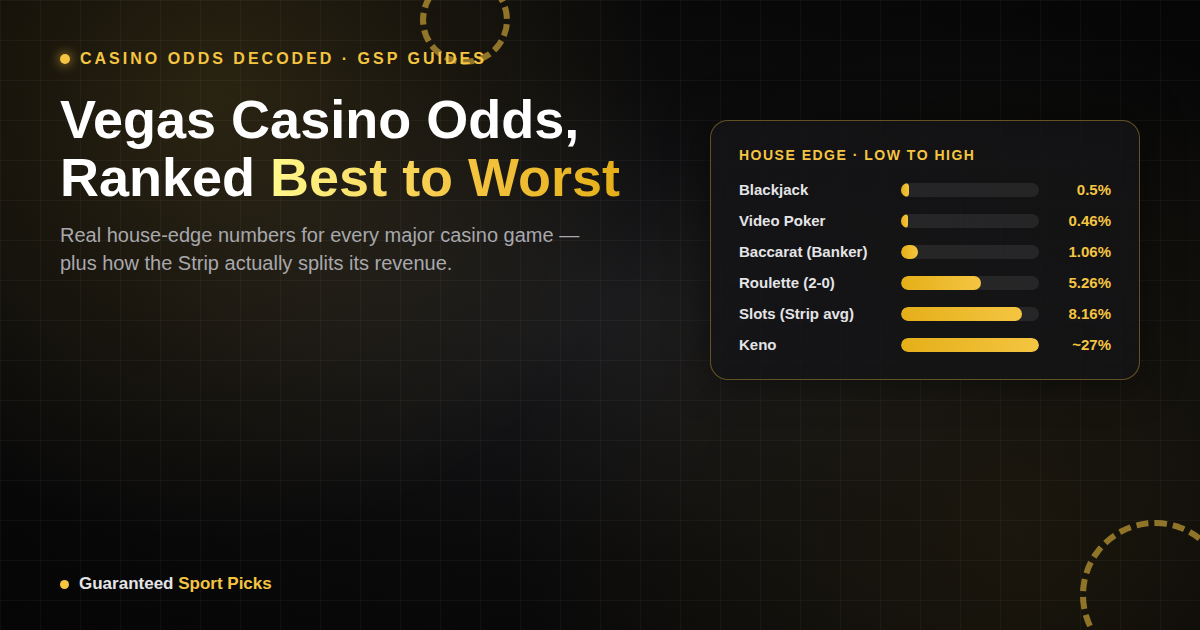
House edge is the share of every dollar wagered that a game is built to keep over the long run. A 1% edge means the casino expects to keep about a dollar per hundred wagered, not on any single hand but across thousands of them. Here is how the games on a Vegas floor stack up:
Two things stand out. The craps Free Odds bet is the only true 0% bet in the building, but you can only make it after placing a Pass Line or Don't Pass bet; you cannot walk up and bet it alone. And blackjack and video poker sit at the top of the list only when played with correct strategy. Stray from basic strategy at the blackjack table and that roughly half-percent edge can climb past 2% without you noticing.
What connects the best bets: they reward knowing the right play in every spot instead of going with your gut. That is not far from disciplined sports betting, where knowing the true price of a bet is what separates a long-term approach from a guess. Our betting basics guide covers the same idea of shopping for value.
Keno is the extreme. An edge of 25% to 29% means the game returns well under 75 cents per dollar over time, roughly lottery-ticket territory. It is a fun, low-stakes way to pass the time with a drink in hand, not a serious bankroll play.
Not all slots are equal
Slots get lumped together as "the worst odds in the casino," but that is too simple. Payback varies by denomination and by where in the valley the machine sits, according to American Casino Guide's annual slot survey. Higher denominations pay back more than penny slots, and locals casinos away from the tourist corridor pay back more than the Strip.
| Area | Penny | Quarter | Dollar |
|---|---|---|---|
| Las Vegas Strip | 88.33% 11.67% edge | 89.34% 10.66% edge | 92.34% 7.66% edge |
| Downtown | 88.96% 11.04% edge | 93.91% 6.09% edge | 94.12% 5.88% edge |
| North Las Vegas / Boulder Strip | 90.79% 9.21% edge | 96.27% 3.73% edge | 95.62% 4.38% edge |
The gap between a Strip penny slot and a North Las Vegas dollar slot is nearly eight percentage points of payback. Over a long session, that is real money.
Casino odds questions
What does house edge mean?
Which casino game has the best odds in Las Vegas?
Which casino game has the worst odds?
Does card counting still work?
Why does baccarat make so much money if its edge is low?
Gambling involves risk and is intended for entertainment purposes for adults 21 and older. Every casino game carries a built-in mathematical edge for the house, and no system or strategy guarantees winnings. Please gamble responsibly. If you or someone you know has a gambling problem, call 1-800-GAMBLER.