




What Is Closing Line Value (CLV) in Sports Betting?
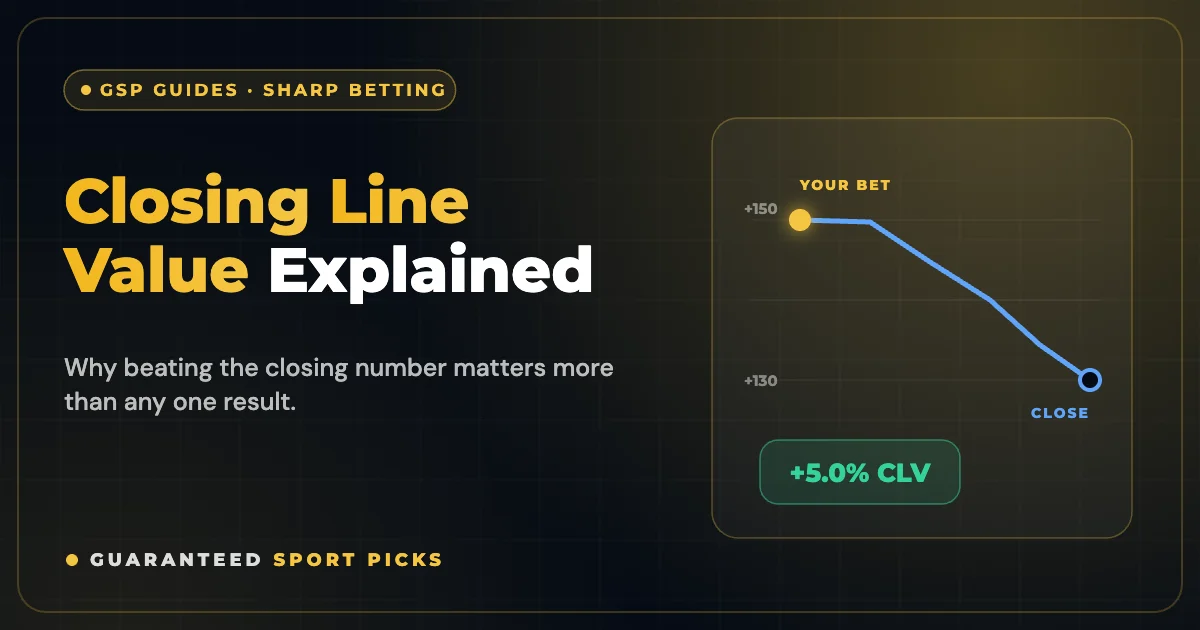
You bet an underdog at +150 on Tuesday. By kickoff on Sunday, the same bet is +130. Your team loses by a field goal. Was it a bad bet? Almost certainly not. You got a better price than the market settled on, and that is the core idea behind closing line value, the number sharp bettors watch more closely than their win-loss record.
What is closing line value?
The closing line is the last price a sportsbook offers before a game locks. By then the market has absorbed nearly everything: injury news, weather, lineup changes and, most importantly, the bets of the sharpest players in the world. That makes the closing line the best available estimate of the true odds for that game.
If you bet a side at a better number than where it closed, you bought it for less than the market ended up valuing it. Do that over hundreds of bets and you will very likely show a profit, even though any single bet can lose. It is the same reason big sharp money moves lines: professionals bet early numbers they think are wrong, and the market follows them.
How to calculate closing line value
The simple version is just comparing prices: you got +150, it closed at +130, you beat it. To measure how much you beat it by, you need to strip the vig out of the closing line so you are comparing against a fair price.
If the odds conversion part is new to you, our odds guide walks through implied probability and decimal odds step by step.
| Your bet | Closing line (both sides) | Fair chance at close | CLV |
|---|---|---|---|
| +150 | +130 / -150 | 42.0% | +5.0% |
| -110 | -130 / +110 | 54.3% | +3.6% |
| +120 | +120 / -140 | 43.8% | −3.7% |
| -105 | -102 / -118 | 48.3% | −5.8% |
| +140 | +155 / -175 | 38.1% | −8.5% |
Closing line value on point spreads
On spreads and totals, CLV is usually measured in points first. If you took a team at -2.5 and it closed -3.5, you beat the close by a full point. Not every half-point is worth the same, though. In the NFL, moving across 3 or 7 is worth far more than moving from 5.5 to 6, because so many games land on those margins. Our guide to NFL key numbers explains why.
Price counts too. Getting -2.5 at -120 and watching it close -3 at -110 is not an automatic win. You gained the half-point through 3 but paid more juice for it. When in doubt, compare the implied probabilities.
Why CLV beats wins and losses as a scorecard
Results are noisy. A bettor who truly wins 55% of their bets, which is excellent, could show anything from about 45% to 65% after 100 bets just from normal variance. Even after 500 bets, the likely range is still about 51% to 59%. It takes a long time for a record to tell you much.
CLV gives you a reading on every single bet, win or lose. If you are consistently beating the close, the wins usually follow. If you are consistently getting worse numbers than the close, a hot streak is probably luck.
How to get more closing line value
- Shop every bet. The easiest CLV is simply taking the best price available. Check the live odds board and keep accounts at more than one of the top sportsbooks.
- Act on news fast. Injury and lineup news moves lines. Being early on real information is where a lot of CLV comes from.
- Know when to wait. If you expect the public to bet a line up, betting the other side later can get you a better number.
- Track it. Log your price and the closing price for every bet. A spreadsheet is enough.
Where CLV falls short
The closing line is the best estimate available, not a perfect one. In big markets like NFL sides and totals, it is very sharp. In smaller markets, like obscure player props or low-limit college games, the close can still be off, so CLV is less reliable there. And sportsbooks watch CLV too: accounts that beat the close by a lot tend to get their limits reduced.
CLV questions
What is a good closing line value?
Does beating the closing line mean you will win?
How do you calculate CLV?
Why is the closing line considered accurate?
Can you have CLV on player props?
Sports betting involves risk and is intended for entertainment purposes for adults 21 and older. Please bet responsibly. If you or someone you know has a gambling problem, call 1-800-GAMBLER.