


✅Loading documented premium-pick record…
💰Pay After You Win — temporary authorization may appear; only wins are captured
🏀NBA Season Package Now Available - Limited Spots
✅Loading documented premium-pick record…
💰Pay After You Win — temporary authorization may appear; only wins are captured
🏀NBA Season Package Now Available - Limited Spots
Guaranteed Sport Picks
Stadium Background
GSP Betting Desk

Betting News & Insights

Practical sports betting analysis built to help you understand the market, evaluate matchups and make more disciplined decisions.

FREE SPORTS PICKS BY EMAIL.

Get our top picks delivered to your inbox daily.

No Spam. Unsubscribe anytime.

How to Read Betting Odds: American, Decimal and Implied Probability
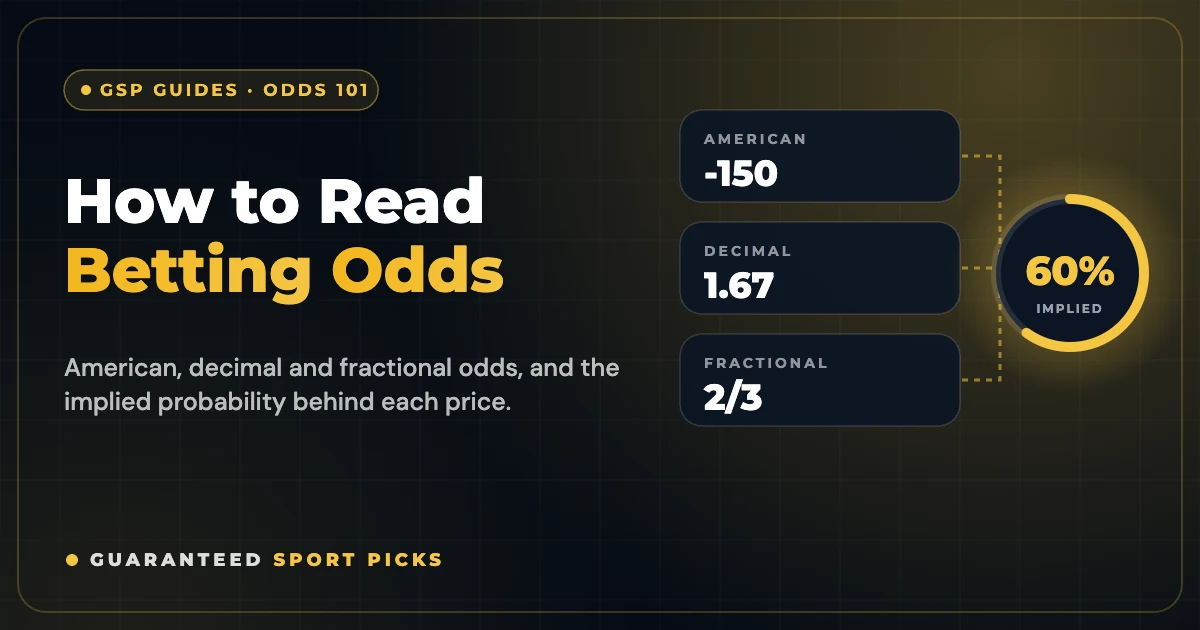
How to Read Betting Odds: American, Decimal and Implied Probability

Betting odds tell you two things at once: how likely the sportsbook thinks something is, and how much you get paid if it happens. The trouble is that the same price can be written three different ways depending on where you bet. Learn to read betting odds once, and every line on every board starts making sense.

The idea in brief
In American odds, a minus sign marks the favorite and shows how much you risk to win $100 (-150 means risk $150 to win $100). A plus sign marks the underdog and shows how much a $100 bet wins (+130 means win $130). Every price also converts into an implied probability.
AMERICAN ODDS AND IMPLIED PROBABILITY -30075% -15060% +10050% +15040% +30025% Favorites: risk more to win $100Underdogs: win more than you risk Implied probability shown before removing the sportsbook's margin
The further a price is from +100 on the minus side, the bigger the favorite. The further on the plus side, the bigger the long shot.

How to read American odds

American odds are the default at U.S. sportsbooks. Everything is framed around $100, which makes quick math easy once you know which way the sign points.

Minus odds: the favorite
Example: -150
•Risk $150 to win $100
•Total return of $250 if it wins
•Bigger minus number, bigger favorite
Plus odds: the underdog
Example: +130
•Risk $100 to win $130
•Total return of $230 if it wins
•Bigger plus number, bigger long shot

Even money is written as +100 (sometimes -100 or EVEN): risk $100 to win $100. The standard price on most point spreads and totals, -110, sits just past even money and pays $90.91 on a $100 bet.

Decimal and fractional odds

Many international books and some apps show decimal odds, which include your stake: 2.50 means every $1 returns $2.50 in total. Fractional odds, common in horse racing and the U.K., show profit over stake: 3/2 means $3 of profit for every $2 risked. All three formats describe the same price.

Common prices in every format
AmericanDecimalFractionalImpliedProfit on $100
-3001.331/375.0%$33.33
-2001.501/266.7%$50.00
-1501.672/360.0%$66.67
-1101.9110/1152.4%$90.91
+1002.001/150.0%$100.00
+1302.3013/1043.5%$130.00
+1502.503/240.0%$150.00
+2003.002/133.3%$200.00
+3004.003/125.0%$300.00
The highlighted -110 row is the default price on most spreads and totals.

How to convert odds to implied probability

1
For minus odds
Divide the odds by the odds plus 100. For -150: 150 / 250 = 60%.
2
For plus odds
Divide 100 by the odds plus 100. For +130: 100 / 230 = 43.5%.
3
For decimal odds
Divide 1 by the decimal price. For 2.50: 1 / 2.50 = 40%.

Implied probability is the break-even point. If you think a team wins more often than its price implies, the bet has value. If less often, it does not, no matter how much you like the team.

Why the two sides add up to more than 100%

Convert both sides of a standard -110/-110 spread and you get 52.4% each, or 104.8% combined. That extra 4.8% is the book's built-in margin. It shows up on every market, so implied probability always runs a little high.

Take a real example from our moneyline vs. point spread guide: Chiefs -260, Jets +210.

Posted prices vs. fair probability
Chiefs -260, as posted72.2%
Jets +210, as posted32.3%
Chiefs, margin removed69.1%
Jets, margin removed30.9%
The posted prices add up to 104.5%. Dividing each side by that total gives a fair estimate that adds to 100%.

Prediction markets skip odds formats entirely and show the price as a probability. Our guide to Kalshi and Polymarket prices explains how those compare.

Betting odds questions

What does +200 mean in betting?
A $100 bet at +200 wins $200 in profit, for a total return of $300. The implied probability is 33.3%.
What does -110 mean?
You risk $110 to win $100. It is the standard price on most point spreads and totals, and it implies a 52.4% chance.
Is a minus or plus number the favorite?
The minus number is the favorite. The larger the minus number, the more the book expects that side to win.
How do I convert American odds to decimal?
For plus odds, divide by 100 and add 1 (+150 becomes 2.50). For minus odds, divide 100 by the odds and add 1 (-150 becomes 1.67).
What is implied probability?
It is the win percentage a price suggests, and the break-even rate you need to profit at that price over time.
Put the numbers to work
Every GSP pick shows the exact price with the pick, so you can check the implied probability yourself. You only pay for picks that win.

Sports betting involves risk and is intended for entertainment purposes for adults 21 and older. Please bet responsibly. If you or someone you know has a gambling problem, call 1-800-GAMBLER.

How to Read Betting Odds: American, Decimal & Fractional | Guaranteed Sport Picks