




Super Bowl Squares: How Football Squares and Boxes Work
Super Bowl squares, called boxes in New York and New Jersey, are a 10-by-10 grid of 100 squares. Each square gets one digit for each team, and it wins when those digits match the last digit of each team's score at the end of a quarter. Nobody needs to know football to play.
How Super Bowl squares and boxes work
One team runs across the top of the grid and the other runs down the side. That gives 100 squares, one for every pairing of a last digit from 0 to 9. People write their name in the squares they buy, and a square costs the same no matter where it sits.
The digits go on only after every square is sold. That order matters. With the numbers hidden, every square has the same 1 in 100 chance, so the pool is a pure draw and nobody can buy the good numbers early.
A quick example. The 2025 season Super Bowl ended Seattle 29, New England 13. The winning final square was Seattle 9, New England 3. At halftime Seattle led 9 to 0, so the halftime square was Seattle 9, New England 0.
Free printable Super Bowl box template
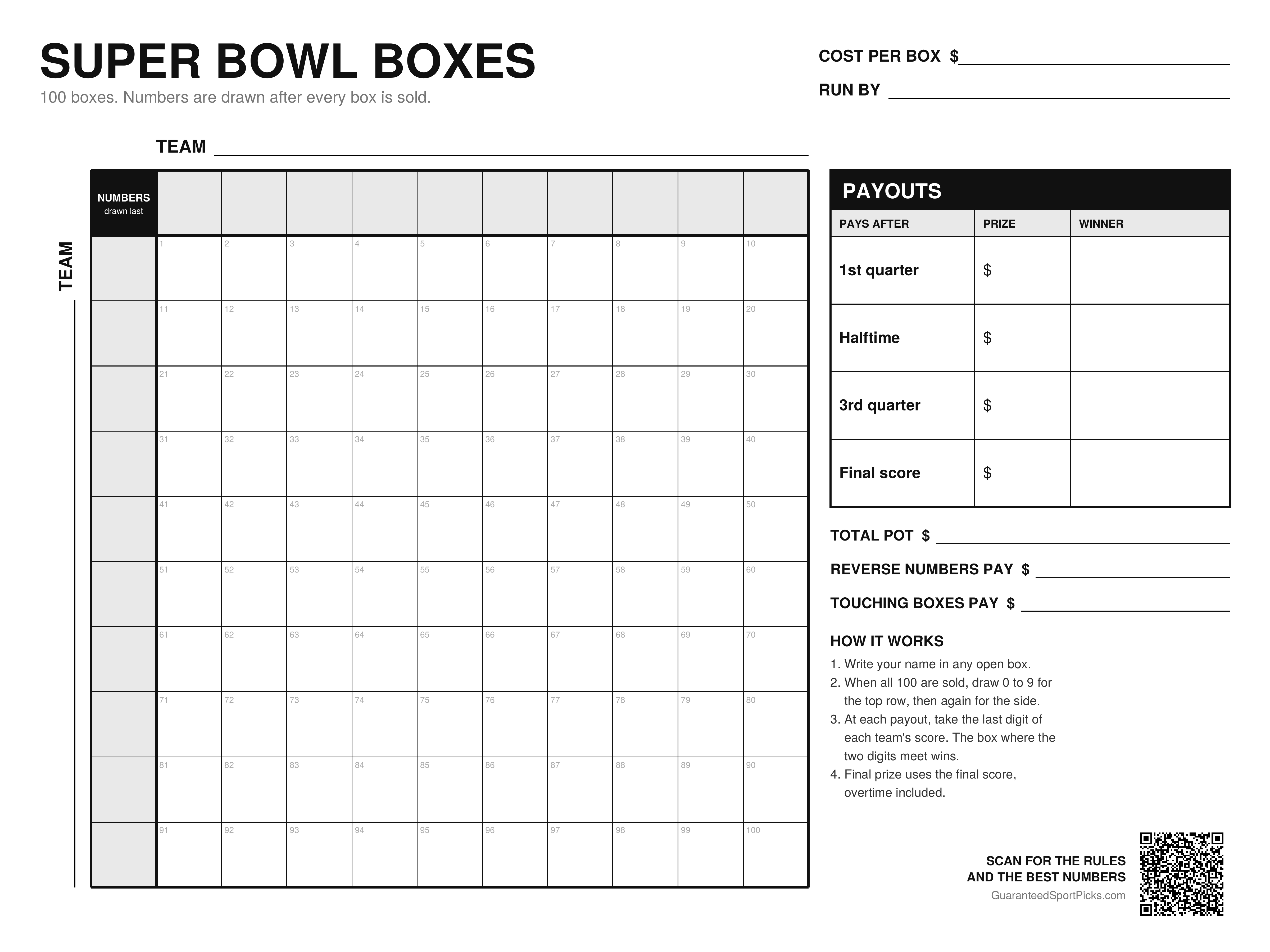
Here is a blank Super Bowl box template you can print and hang. It is sized for a 24 by 18 inch poster board and stays sharp on regular paper too. One version has a payouts table on the side, and the other is the grid alone.
Template 1: grid with payouts and how-toPreview
Template 2: grid onlyPreview
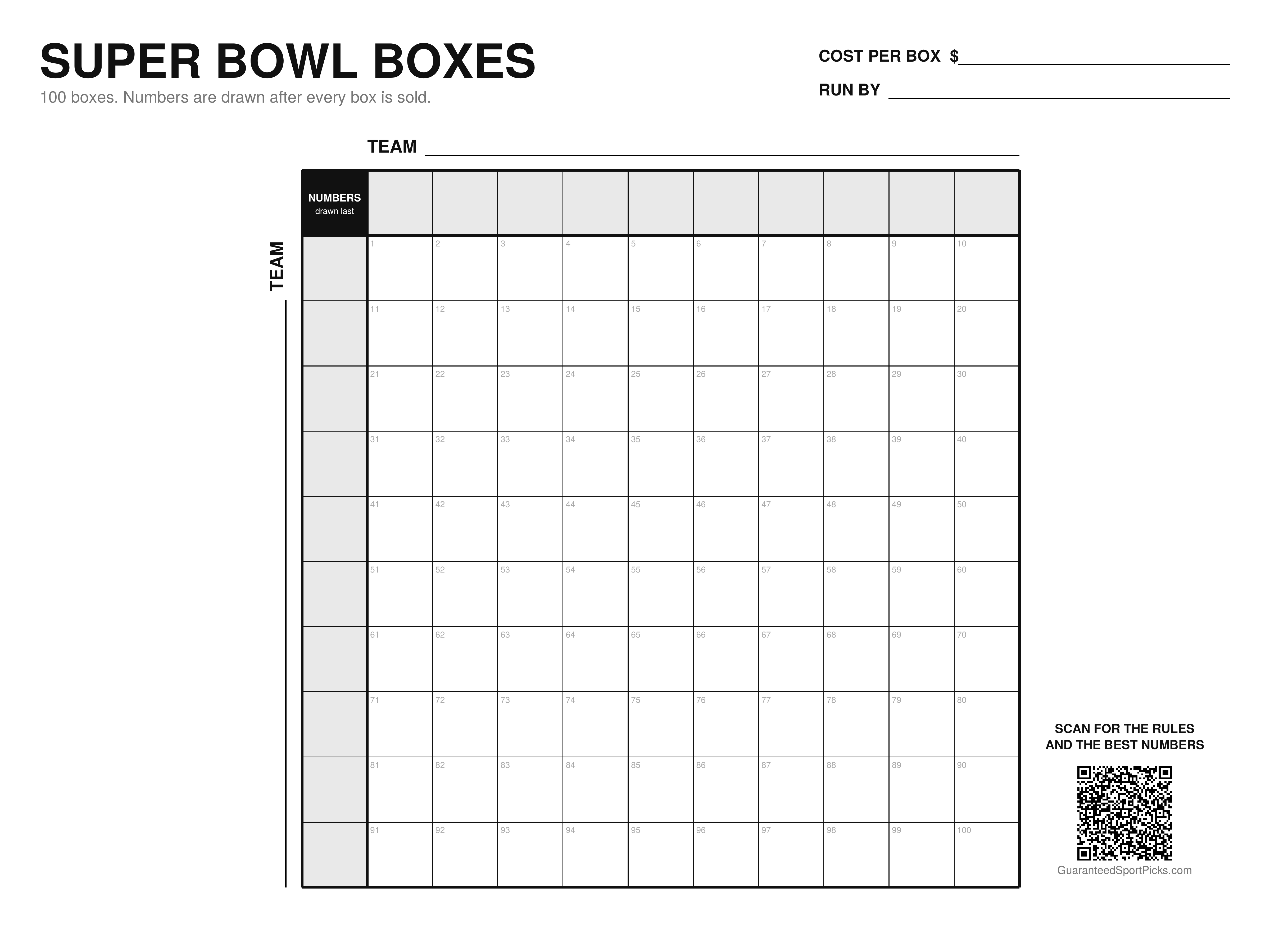
Both files have blank lines for the two teams, the cost per box and who is running the pool. The boxes are numbered 1 to 100 so players can call out the one they want.
How squares pay out
The pot is the price of a square times 100. A $10 grid holds $1,000 and a $100 grid holds $10,000. The two payout plans below cover most pools we have seen. The final score almost always pays the most.
| Payout plan | 1st quarter | Halftime | 3rd quarter | Final |
|---|---|---|---|---|
| Even quarters | 25% | 25% | 25% | 25% |
| Final pays most | 20% | 20% | 20% | 40% |
| Half and final heavy | 12.5% | 25% | 12.5% | 50% |
| Final only | 0 | 0 | 0 | 100% |
The final prize goes by the final score, overtime included, unless the sheet says otherwise. If the game goes to overtime, the fourth quarter score and the final score can be different squares. Decide before kickoff whether the end of regulation pays as its own prize.
Squares and box pool variations worth knowing
The standard grid is the one to learn first. Once a group has played it a few years, these are the changes people add to spread the money around or keep the weak numbers alive.
| Variation | How it works |
|---|---|
| Reverse payout | The flipped digits also win a smaller prize. If 7 and 0 wins, the 0 and 7 square gets a share too. |
| Touching squares | The squares directly next to the winner each get a small cut. |
| New numbers each quarter | Digits are redrawn for every quarter, so one bad draw does not sink a player for the whole game. |
| Every score change | A prize is paid after each score, often with a bigger one held for the final. |
| Half grids | A 25 or 50 square grid where each row or column carries two or four digits. Good for small groups. |
| Halves only | Two payouts, halftime and final, usually split 25% and 75% or close to it. |
Reverse payouts are the most common add-on. They give a player who drew a 2 or a 5 another way to cash, and they cost the main winner only a slice of the prize.
Bar boxes and big-money pools
In New York and North Jersey nearly every bar runs its own boxes for the Super Bowl. Most are $20 to $100 a box. Some run $1,000 or even $5,000 a box, and friends often go in together to split one.
The custom at a lot of bars is that winners leave a tip for the house, often around 5%, and the rest of the pot goes to the winners. That is custom, not law. In many states a pool is only on safe ground when all the money is paid back out and the organizer keeps nothing.
Rules on private pools change from state to state, so check yours before running a big one. Winnings are also income as far as the IRS is concerned, whatever the size of the pool and whoever ran it.
Do some squares win more than others?
Position on the grid means nothing. The corner, the middle and the edge all have the same chance until the digits are drawn. After the draw it is a different story, because football scores move in 3s and 7s.
We counted every quarter of 1,425 NFL games. A square holding 0 and 7 collected about 6.8% of an even-quarters pot on average, close to seven times its fair share. The 2 and 2 square collected 0.04%. The full grid is on our best Super Bowl squares numbers page.
Rules to settle before kickoff
- What each payout is, in dollars, written on the sheet.
- Whether the final prize uses the final score or the end of regulation.
- What happens to unsold squares. Most pools give them to the house or roll that share to the final.
- How many squares one person can buy.
- Who holds the money and when winners get paid.
Take a photo of the finished grid once the numbers are on it and send it to everyone. It ends most arguments before they start.