


✅Loading documented premium-pick record…
💰Pay After You Win — temporary authorization may appear; only wins are captured
🏀NBA Season Package Now Available - Limited Spots
✅Loading documented premium-pick record…
💰Pay After You Win — temporary authorization may appear; only wins are captured
🏀NBA Season Package Now Available - Limited Spots
Guaranteed Sport Picks
Stadium Background
GSP Betting Desk

Betting News & Insights

Practical sports betting analysis built to help you understand the market, evaluate matchups and make more disciplined decisions.

FREE SPORTS PICKS BY EMAIL.

Get our top picks delivered to your inbox daily.

No Spam. Unsubscribe anytime.

What Is a Point Spread?
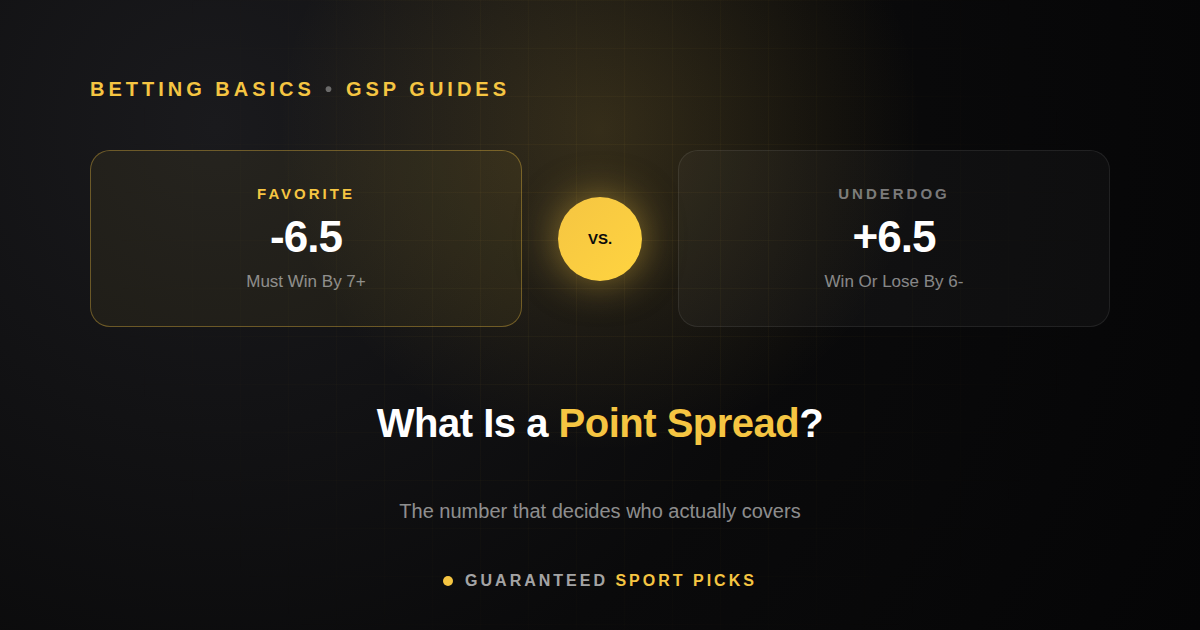
What Is a Point Spread?

The point spread settles most bets before kickoff, and it is also the number newer bettors misread most often. It is not complicated. It just measures something different from what it looks like, and nobody tends to explain that until after the first bet goes sideways.

In one sentence
A point spread is a margin the sportsbook sets so that either side of a game is a reasonable bet: the favorite has to win by more than the number, and the underdog covers by winning outright or losing by less than it.

It is not a score prediction

A spread looks like a forecast, but that is not its job. The number is set so that betting either side feels like a close call, and books keep adjusting it as money comes in. If the Cowboys are -6.5 against the Giants, that does not mean anyone expects Dallas to win by exactly six and a half. It means the book thinks -6.5 makes both sides roughly equally attractive.

Reading the plus and the minus

The favorite (minus)
Cowboys -6.5
•Gives up 6.5 points
•Has to win by 7 or more to cover
•Winning by 6 still loses the bet
The underdog (plus)
Giants +6.5
•Gets 6.5 points of cushion
•Covers by winning outright
•Also covers by losing by 6 or fewer

Only one side can cover a given spread. -6.5 and +6.5 are the same bet described from opposite ends of the field.

Winning vs. covering, on one line

Here is the idea that trips people up, drawn out. The Chiefs are -3.5 against the Broncos. Every box below is a possible Chiefs margin of victory:

CHIEFS MARGIN OF VICTORYLose by 1: Broncos cover-1Tie: Broncos cover0Win by 1: Broncos cover+1Win by 2: Broncos cover+2Win by 3: Broncos cover+3Win by 4: Chiefs cover+4Win by 5: Chiefs cover+5Win by 6: Chiefs cover+6Win by 7: Chiefs cover+7Win by 8: Chiefs cover+8Win by 9: Chiefs cover+9-3.520-1924-17Chiefs -3.5 coversBroncos +3.5 covers
A 20-19 Chiefs win is a win for Kansas City and a loss for anyone who bet Chiefs -3.5.

If Kansas City wins 24-17, that 7-point margin clears 3.5 with room to spare and Chiefs bettors cash. If Kansas City wins 20-19, the team won but the bet lost, because a 1-point margin never cleared the number. That gap between "won the game" and "covered the spread" is the whole concept.

Why so many spreads end in .5

Books often hang a half point, -6.5 instead of -6 or -7, to take the push off the table. Games end on whole numbers, so a half-point spread always produces a winner. When a book uses a whole number like -7, a final margin of exactly 7 refunds both sides, and in football that happens more than you would think, since 3 and 7 are the most common final margins.

Point spread vs. moneyline
Point spreadMoneyline
What you are betting onWhether a team covers a set marginWhich team wins outright
Typical pricesClose to -110 on both sidesFavorite pays less, underdog pays more
Works best whenOne team is clearly betterYou simply want to back the winner
Weighing the two for a specific game? Our moneyline vs. point spread guide walks through when each one makes sense.

Point spread questions, answered

What is a point spread in sports betting?
It is the margin a sportsbook sets on a game so that betting the favorite and betting the underdog are roughly equally attractive, instead of everyone piling onto the obvious winner.
What does it mean to cover the spread?
Covering means winning the bet against the spread. A favorite covers by winning by more than the number. An underdog covers by winning outright or losing by less than the number.
Why is the spread different from the expected score?
The spread is built to balance betting interest on both sides, not to call the exact final score. Books move it based on where the money lands, not only on team strength.
What if the final margin lands exactly on the spread?
That is a push, and both sides get their stake back. It can only happen on a whole-number spread like -7, never on a half-point spread like -7.5.
Knowing the number is step one
Finding the side with real value is the hard part. Every GSP pick comes with the line, the price and the reasoning, and you only pay if it wins.

Sports betting involves risk and is intended for entertainment purposes for adults 21 and older. Please bet responsibly. If you or someone you know has a gambling problem, call 1-800-GAMBLER.

What Is a Point Spread? How Covering Works | Guaranteed Sport Picks