




NFL Ties: How Many in History, Overtime Rules and What Happens to Your Bet
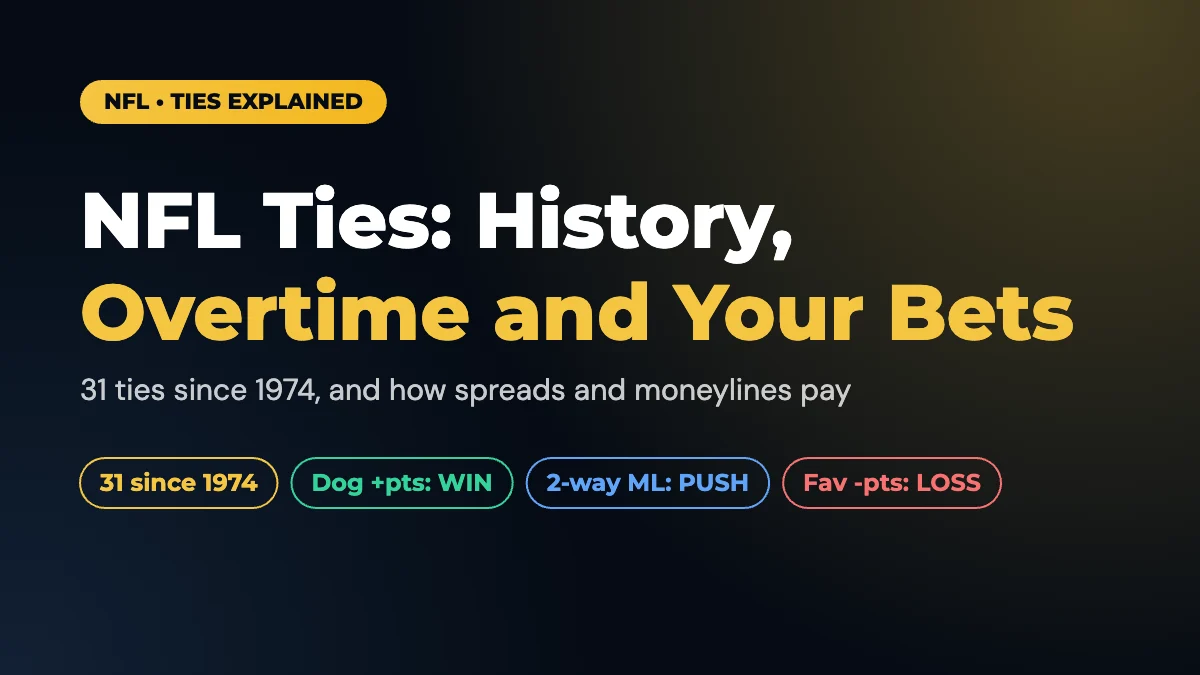
NFL games can end in a tie, and on Sunday, October 11, 2026, one did: the New York Giants and Washington Commanders played to a 27-27 draw after 10 minutes of overtime. It was the 31st tie since the NFL added regular-season overtime in 1974, and the first since the Packers and Cowboys finished 40-40 in September 2025. Ties are rare, but when one hits, it changes how every bet on the game is graded. Here is the history of NFL ties, how overtime works now, and what happens to a spread, moneyline or total bet when the final score is level.
Can NFL games end in a tie?
Yes, in the regular season. If the score is tied at the end of regulation, the teams play one 10-minute overtime period. Since 2025, both teams get at least one possession, even if the team that gets the ball first scores a touchdown. If it is still tied after both possessions, the game becomes sudden death and the next score wins. If nobody has won when the 10 minutes run out, the game goes into the books as a tie. In the playoffs, overtime keeps going until there is a winner, so a postseason game can never end tied.
In the standings, a tie counts as half a win and half a loss, a rule the NFL has used since 1972. That is why the Giants left Washington at 3-1-1, a .700 winning percentage, and the Commanders at 1-3-1.
NFL overtime rules and how they changed
Overtime has gone through four versions since 1974, and the length of the period is the biggest reason ties still happen. When the league cut regular-season overtime from 15 minutes to 10 in 2017, it accepted that more games would end level. The 2025 change that guarantees both teams a possession can eat up more of that 10 minutes before sudden death even starts.
| Seasons | Overtime format | Ties |
|---|---|---|
| 1974 to 2011 | 15-minute sudden death | 17 |
| 2012 to 2016 | 15 minutes, a first-possession field goal no longer ends it | 5 |
| 2017 to 2024 | 10 minutes, modified sudden death | 7 |
| 2025 to now | 10 minutes, both teams get the ball | 2 |
How many ties in NFL history?
Since overtime arrived in 1974, there have been 31 ties in the regular season through October 11, 2026. Before 1974, regular-season games that were tied after four quarters simply ended that way, so ties were routine and the pre-overtime era produced hundreds of them. In the overtime era, a season with two or more ties has happened only five times: 1986, 1997, 2016, 2018 and 2022.
A few ties stand out. The Packers and Cowboys set the high-water mark at 40-40 in Dallas on September 28, 2025, when Green Bay kicked a field goal on the final play of overtime to answer Dallas's go-ahead kick. The lowest-scoring tie since 2000 was a 6-6 game between Seattle and Arizona in 2016. The Giants and Washington now have three ties since 1974 (7-7 in 1997, 20-20 in 2022 and 27-27 in 2026), tied with the Packers and Vikings for the most of any matchup.
| Date | Game | Score |
|---|---|---|
| Oct 11, 2026 | Giants at Commanders | 27-27 |
| Sep 28, 2025 | Packers at Cowboys | 40-40 |
| Dec 4, 2022 | Commanders at Giants | 20-20 |
| Sep 11, 2022 | Colts at Texans | 20-20 |
| Nov 14, 2021 | Lions at Steelers | 16-16 |
| Sep 27, 2020 | Bengals at Eagles | 23-23 |
| Sep 8, 2019 | Lions at Cardinals | 27-27 |
| Sep 16, 2018 | Vikings at Packers | 29-29 |
| Sep 9, 2018 | Steelers at Browns | 21-21 |
| Oct 30, 2016 | Washington vs Bengals | 27-27 |
| Oct 23, 2016 | Seahawks at Cardinals | 6-6 |
| Oct 12, 2014 | Panthers at Bengals | 37-37 |
| Nov 24, 2013 | Vikings at Packers | 26-26 |
| Nov 11, 2012 | Rams at 49ers | 24-24 |
| Nov 16, 2008 | Eagles at Bengals | 13-13 |
| Nov 10, 2002 | Falcons at Steelers | 34-34 |
What happens to your bet if an NFL game ends in a tie?
A tie hits each bet type differently, because each one asks a different question. Here is how a standard US sportsbook grades them, using Sunday's Giants-Commanders game as the example. The game lines were Commanders -3.5, a total of 41.5, and moneylines of about Commanders -177 and Giants +148, per FOX Sports' odds board. Rules can vary, so check your book's house rules, and compare books on our sportsbooks page.
| Bet | Result on a tie | Why |
|---|---|---|
| Point spread, favorite (Commanders -3.5) | Loses | A tie means the favorite won by zero, so it fails to cover any minus number. |
| Point spread, underdog (Giants +3.5) | Wins | The underdog covers any plus number when the game ends level. |
| Point spread at pick'em (0) | Push | Neither side covers, so both get their stake back. |
| Moneyline, two-way (either team) | Push, refunded | Most US books void or refund a two-way NFL moneyline on a tie. |
| Moneyline, three-way (tie offered) | Tie wins, both teams lose | The tie is its own priced outcome, usually a long shot. |
| Game total (41.5) | Over wins | Full-game totals include overtime: 27 plus 27 is 54. |
| First-half bets | Unaffected | Overtime and the second half never touch a first-half ticket. |
| Parlay with a tied moneyline leg | Leg removed | The tied leg drops out and the parlay pays at the shorter odds. |
Point spread: the underdog wins, the favorite loses
A point spread bet asks whether a team wins by more than the number (favorite) or loses by less than it (underdog). A tie is a zero-point margin. So Giants +3.5 won, because the Giants lost by less than 3.5 points (they did not lose at all), and Commanders -3.5 lost. The same logic applies to any spread: a tied game is a winner for every plus number and a loser for every minus number. The only spread that pushes on a tie is a pick'em, listed as 0 or PK. Our pick on that game was Giants +3.5, and the tie cashed it. For more on how spreads work, see what is a point spread.
Moneyline: usually a push
A two-way moneyline asks only who wins, and in a tie nobody did. At most US sportsbooks, both sides of a two-way NFL moneyline are graded as a push or void and the stake is refunded. BetMGM and FanDuel both describe it that way in their betting guides. Some books also post a three-way moneyline that lists the tie as its own outcome at a long price; on that market, a tie cashes the tie bet and both team bets lose. Our guide to moneyline vs point spread covers when each bet makes sense.
Totals: overtime counts
Full-game over/under bets include overtime unless the bet says otherwise, so the total is graded on the final score. Sunday's 27-27 finish produced 54 points, well over the 41.5 total. First-half and first-quarter bets are graded before overtime, so a tie has no effect on them; our page on NFL first half lines explains those markets.
Parlays: the tied leg drops out
If a parlay includes a moneyline that pushes because of a tie, that leg is removed and the parlay is regraded with one fewer leg at shorter odds. It is not an automatic loss. A spread leg on the underdog, on the other hand, counts as a win. See what is a parlay bet and what is a push in betting for how pushes are handled.
Should you plan for ties when you bet?
Not much. With 31 ties in more than five decades of overtime football, a tie is a small edge case, not a betting angle. It matters most in two spots. First, on a two-way moneyline, a tie gives your money back instead of paying, so a big underdog moneyline bet gains nothing from a tie that a plus-spread bet would have won. Second, a three-way moneyline gives you a payout on the tie itself, but the price reflects how rarely it happens. The practical lesson is to know the rule before you bet, so a tie is a pleasant surprise rather than a confusing one.
NFL tie questions
How many ties have there been in NFL history since overtime?+
When was the last NFL tie?+
What happens to a moneyline bet if an NFL game ends in a tie?+
Does the underdog cover the spread if an NFL game ends in a tie?+
How long is NFL overtime?+
Sports betting involves risk and is intended for entertainment purposes for adults 21 and older. Please bet responsibly. If you or someone you know has a gambling problem, call 1-800-GAMBLER.