




First Half Betting Explained: 1H Spreads, Totals and Moneylines
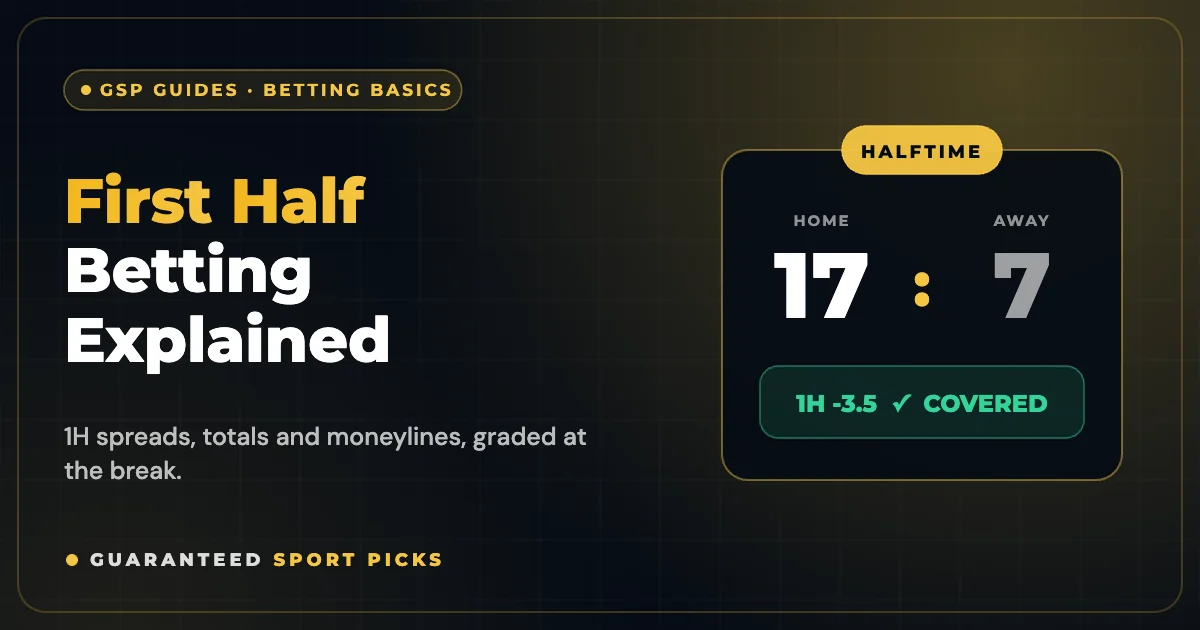
Some teams come out of the locker room with a sharp script and fade in the fourth quarter. Others start slow and wake up late. If you only trust a team for the first 30 minutes, you do not have to bet all 60. First half betting lets you bet on the score at halftime, with its own spread, total and moneyline.
How first half bets work
Most sportsbooks post first half lines for every NFL and college football game. They look just like full-game lines, with smaller numbers:
The spread and total work exactly like their full-game versions. If you need a refresher, see our guides to point spreads and over/under bets.
How first half lines are set
Oddsmakers start with the full-game numbers and scale them down, then adjust for how each team tends to play early. A team with a strong opening script or an aggressive coach may get a bigger first half number than simple halving would suggest. A team that leans on its defense and grinds late may get a smaller one.
| Market | Full game | First half |
|---|---|---|
| Spread | -6.5 | -3.5 |
| Total | 45.5 | 22.5 |
| Moneyline | -280 | -180 |
Key numbers in the first half
In the NFL, 3 and 7 are the most important key numbers for full games, and they matter at halftime too. There is also a first half number that does not really exist for full games: zero. Scoreless and tied halves are common enough that a first half line of -0.5 is a very different bet from a pick'em. That is also why you will see so many 1H spreads of -0.5 and -1.5.
First half vs. second half vs. full game
| First half | Second half | Full game | |
|---|---|---|---|
| Quarters counted | Q1 and Q2 | Q3 and Q4 | All four |
| Overtime | Never | Usually yes | Yes |
| Line posted | Before kickoff | At halftime | Before kickoff |
| Main risk | Halftime ties | Fast-moving live line | Late-game swings |
Second half lines are posted at halftime and move fast, so they behave more like live betting. Check your sportsbook's house rules on overtime for second half bets; most include it.
Why bettors use first half bets
- Back a fast starter. If a team is at its best early and wears down late, the first half isolates what you like about it.
- Skip late-game chaos. Garbage-time touchdowns, backdoor covers and meaningless field goals happen in the second half. A first half bet avoids them.
- Avoid rest and blowout risk. In lopsided college games, starters often sit in the second half. The first half is when the favorite's best players are on the field.
- Weather. If wind or rain is forecast to get worse as the game goes on, a first half total can be a cleaner bet than a full-game total.
The risks
A shorter game means more randomness. One turnover or one long touchdown has more impact over 30 minutes than over 60. Halftime ties can sink moneyline and small-spread bets. And limits on first half markets are often lower than on full-game lines at many books. Treat first half bets as a tool for specific situations, not a replacement for full-game betting.
Example: grading a first half bet
You bet the favorite -3.5 in the first half and the first half over 22.5. Here is how three different halftime scores grade:
| Halftime score | Margin | 1H -3.5 | Total points | 1H over 22.5 |
|---|---|---|---|---|
| Favorite 17, Underdog 7 | +10 | Win | 24 | Win |
| Favorite 10, Underdog 7 | +3 | Loss | 17 | Loss |
| Favorite 7, Underdog 7 | 0 | Loss | 14 | Loss |
How to place a first half bet
First half betting FAQ
What does 1H mean in betting?
Does overtime count in first half bets?
What happens to a first half moneyline if the game is tied at halftime?
Is the first half line always half of the full-game line?
Does the second half bet include overtime?
Sports betting involves risk and is intended for entertainment purposes for adults 21 and older. Please bet responsibly. If you or someone you know has a gambling problem, call 1-800-GAMBLER.