What Is an Over/Under Bet? Totals Betting Explained
You do not need to pick a winner to bet on a football game. An over/under bet asks a simpler question: will both teams combine for more points than the sportsbook expects, or fewer? It is one of the most popular bets in the NFL and college football, and once you see how the number is built, it is one of the easiest to follow from the first snap.
Over/under, in one sentence
An over/under bet, also called a total, is a wager on whether the combined final score of both teams lands above (over) or below (under) a number the sportsbook sets before the game.
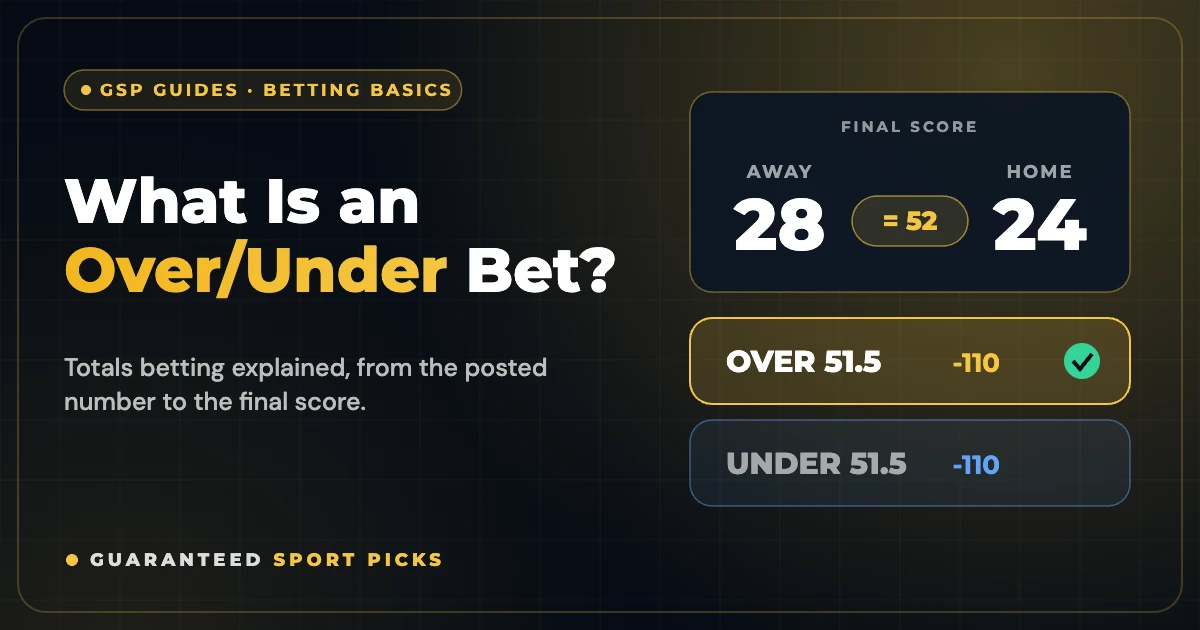
With the total at 51.5, a 28-24 final adds up to 52 and cashes every over ticket.
How over/under bets work
The sportsbook posts one number for the game, say 51.5. You choose a side. If you bet the over, you need the two teams to score 52 or more points combined. If you bet the under, you need 51 or fewer. Who wins the game does not matter at all, and neither does the margin. A 45-7 blowout and a 26-26 overtime thriller grade exactly the same if they add up to the same total.
1
Find the posted total
It sits next to the spread and moneyline, usually shown as O 51.5 and U 51.5.
2
Pick over or under
Over means more combined points than the number; under means fewer.
3
Add up the final score
Overtime counts on a full-game total. Compare the sum with the number to see how your bet grades.
Reading the price on a total
Most NFL and college football totals are priced at -110 on both sides, meaning you risk $110 to win $100 whichever way you go. That price hides the sportsbook's cut, known as the vig. At -110, you need to win about 52.4% of your total bets just to break even.
-110
Standard price
Each side of most totals
52.4%
Break-even win rate
At -110 on every bet
.5
Why totals use half points
It removes the chance of a push
If a book shades one side, say over -115 and under -105, that tells you where it expects more money or sees more risk. The number and the price move together, so always read both.
Real totals from the NFL's Week 3 board
Here is how the totals looked on some of the biggest games in our NFL Week 3 preview. The spread between the highest and lowest numbers tells you a lot about how the market sees each matchup.
Week 3 NFL totals, as posted in our preview
Ravens vs. Cowboys (Rio)51.5
Falcons at Packers44.5
Chiefs at Dolphins44.5
Rams at Broncos44.5
Bengals at Steelers43.5
Eagles at Bears43.5
Opened at 46.5, fell after a quarterback injury
The Eagles-Bears drop is a good example of what moves a total. Chicago's starting quarterback was hurt, the market expected less scoring, and the number fell three full points.
What moves a total
Pushes the number up
•Two fast-paced, pass-first offenses
•Weak or injured defenses
•A dome, or calm and dry weather
•Healthy starting quarterbacks
Pulls the number down
•Strong wind, heavy rain or snow
•A backup quarterback starting
•Run-heavy teams that drain the clock
•Elite defenses on both sides
Wind matters more than cold for most totals, because it limits the passing game and kicking range. Quarterback news tends to move totals fastest of all.
Worked example: one game, four finals
Say the total is 51.5 and you bet the over at -110, risking $110 to win $100. Here is how four possible finals grade. The last column shows what would happen if the book had used a whole-number total of 51 instead.
Illustrative finals against a 51.5 total
Final score
Combined
Over 51.5
If total were 51
28-24
52
+$100
Over wins
27-24
51
-$110
Push, stake back
31-27
58
+$100
Over wins
24-17
41
-$110
Under wins
On a whole number, a final that lands exactly on the total is a push, and every bet is refunded.
Other kinds of totals
Team totals
•Bet on one team's points only
•Useful when you like an offense but not the matchup
First-half totals
•Only the first two quarters count
•Removes overtime and late-game strategy
Alternate totals
•Pick a different number at a different price
•A lower over or higher under costs more
Over/under questions
What does over/under mean in betting?
It is a bet on the combined score of both teams. You win the over if the total points go above the posted number and the under if they stay below it.
Does overtime count in an over/under bet?
Yes, on a full-game total. Overtime points count toward the final combined score unless the bet is specifically a regulation or first-half total.
What happens if the score lands exactly on the total?
On a whole-number total, that is a push and your stake is returned. Half-point totals like 44.5 make a push impossible.
How are over/under lines set?
Books start from projected scoring for each team, then adjust for pace, injuries, weather and where the money comes in. Quarterback news and wind move totals the most.
Is betting the under or the over better?
Neither is better on its own. What matters is whether the number is off. Comparing totals across books helps, since a half point can decide a bet.
Sports betting involves risk and is intended for entertainment purposes for adults 21 and older. Please bet responsibly. If you or someone you know has a gambling problem, call 1-800-GAMBLER.
What Is an Over/Under Bet? Totals Betting Explained | Guaranteed Sport Picks