




Horse Racing Odds Explained: Morning Line, Pari-Mutuel Pools and Payouts
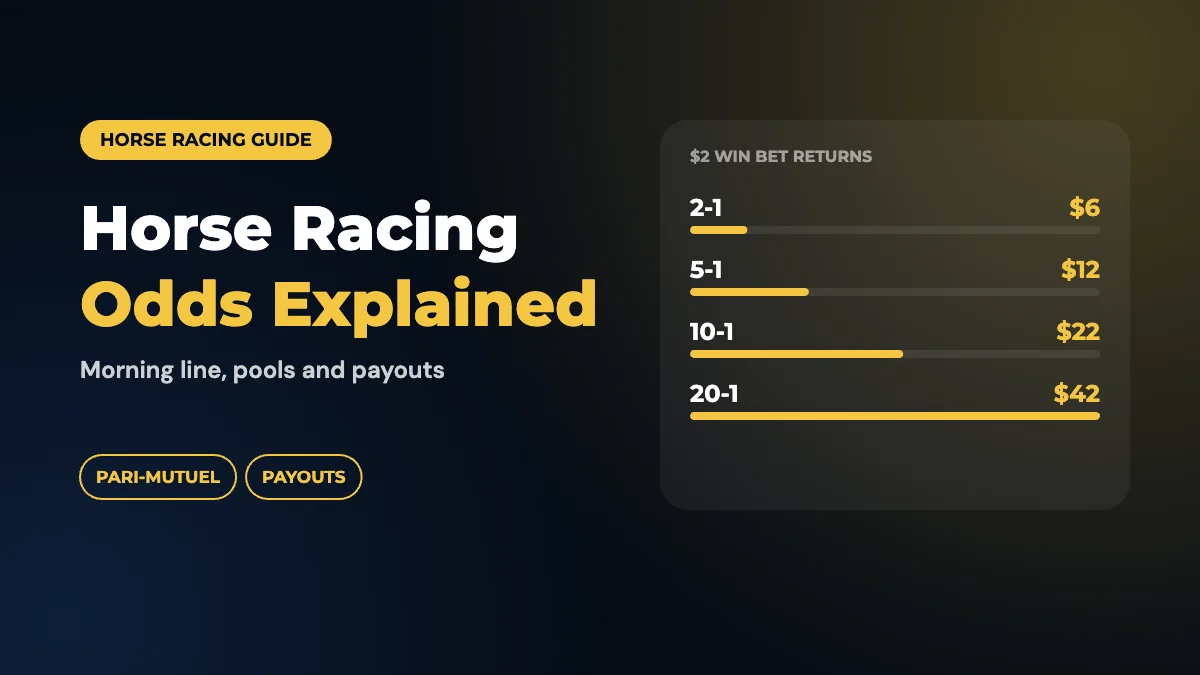
Horse racing odds show how much profit a winning bet pays against the stake. A horse at 5-1 pays $5 for every $1 bet, so a $2 win ticket returns $12. The odds are set by the betting pool, not by a bookmaker, and they keep changing until the race starts.
How to read horse racing odds
The first number is profit and the second is stake. At 5-2 you win $5 for every $2 bet. To get the return on a $2 ticket, divide the first number by the second, multiply by 2, then add your $2 back.
| Odds | $2 win bet returns | Implied win chance |
|---|---|---|
| 1-1 (even money) | $4.00 | 50.0% |
| 2-1 | $6.00 | 33.3% |
| 5-2 | $7.00 | 28.6% |
| 5-1 | $12.00 | 16.7% |
| 10-1 | $22.00 | 9.1% |
| 20-1 | $42.00 | 4.8% |
Implied probability is the share of the time a horse has to win for the bet to break even. Add up every horse in a race and the total comes to more than 100%. The extra is the track's takeout.
How pari-mutuel odds are calculated
- 1Add up the poolSay $10,000 is bet to win on a race.
- 2Remove the takeoutAt a 16% win takeout, the track keeps $1,600 and $8,400 is left for winners.
- 3Subtract the money on the winnerIf $2,000 was bet on the winning horse, that stake goes back to those bettors. $6,400 in profit remains.
- 4Divide profit by the money on the winner$6,400 divided by $2,000 is $3.20 per $1 bet. The board shows 3-1, and a $2 ticket pays $8.40.
Payouts are rounded down, usually to the nearest 10 cents on the dollar. That rounding is called breakage. The 16% in this example is Keeneland's published win takeout, and other tracks and bet types run higher.
What are morning line odds?
The morning line is the track oddsmaker's estimate of where each horse's odds will finish. It is printed in the program before betting opens. It is a forecast, not a price anyone can bet.
Compare the morning line to the live odds. A horse listed at 8-1 in the program and bet down to 3-1 is taking far more money than expected. A horse drifting above its morning line is being ignored.
Why horse racing odds change after you bet
In a pari-mutuel pool you are paid at the final odds. If you bet a horse at 6-1 and late money drives it to 4-1, you are paid at 4-1. A large share of the pool arrives in the last few minutes, so late swings are normal.
Sports betting works the other way. A sportsbook locks your price when you bet, which is why line shopping matters there. Our guide on how to read betting odds covers American odds such as -110 and +150.
Favorites, longshots and value
The favorite is the horse with the lowest odds, also called the chalk. A longshot has high odds and wins less often. Neither is a good or bad bet on its own.
Value is when a horse's real chance is better than its odds imply. A horse you think wins one race in four is a good bet at 5-1 and a poor one at 2-1. Learning to judge that chance is covered in how to handicap a horse race.