




Implied Probability in Betting: How to Convert Odds to a Percentage
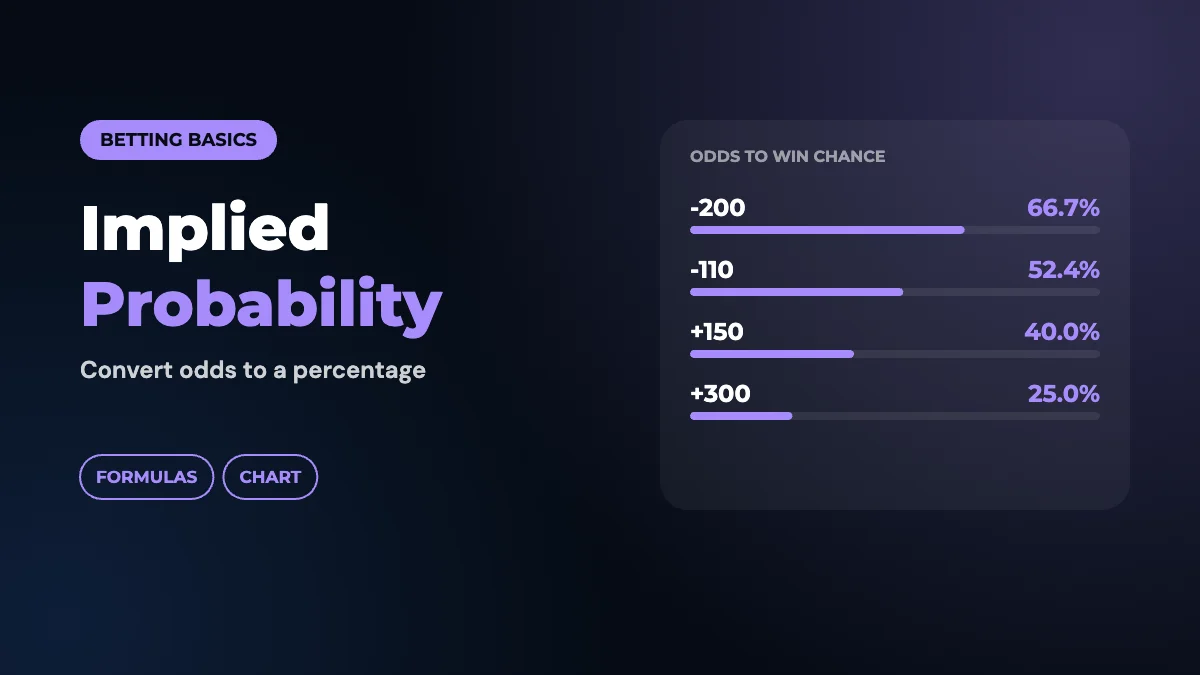
Implied probability is the win chance built into a set of betting odds. At -110 it is 52.4%. At +150 it is 40%. It tells you how often a bet has to win to break even, which makes it the fastest way to judge whether a price is fair.
Implied probability chart for American odds
| Odds | Implied probability | Odds | Implied probability |
|---|---|---|---|
| -110 | 52.4% | +100 | 50.0% |
| -120 | 54.5% | +120 | 45.5% |
| -150 | 60.0% | +150 | 40.0% |
| -200 | 66.7% | +200 | 33.3% |
| -300 | 75.0% | +300 | 25.0% |
| -500 | 83.3% | +500 | 16.7% |
Why both sides add up to more than 100%
Take a game priced at -150 and +130. The two implied probabilities are 60% and 43.5%, which total 103.5%. The extra 3.5% is the sportsbook's margin, known as the vig.
To see the market's real estimate, divide each side by the total. The favorite becomes 58.0% and the underdog 42.0%. These are called no-vig or fair probabilities.
- 1Convert both sides-150 is 60.0% and +130 is 43.5%.
- 2Add them60.0 + 43.5 = 103.5.
- 3Divide each by the total60.0 / 103.5 = 58.0% and 43.5 / 103.5 = 42.0%.
How to use implied probability
A bet has value when your estimate of the win chance is higher than the implied probability. If you make a team 45% to win and the price is +150, which implies 40%, the bet is worth making.
If the price is +110, which implies 47.6%, the same opinion is a pass. This is the idea behind expected value, and it is how we judge every play on our free picks page.
Prediction markets show the number directly. A contract trading at 62 cents implies a 62% chance, as we cover in how to read Kalshi and Polymarket odds.