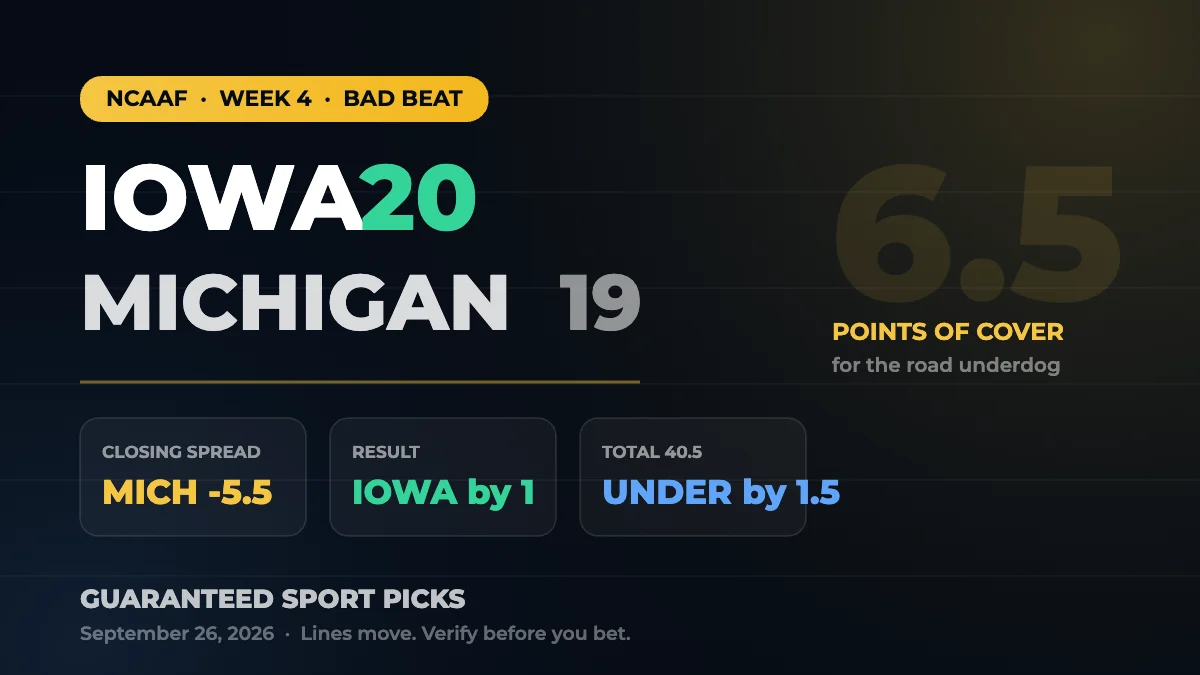
Iowa 20, Michigan 19: Anatomy of a Week 4 Bad Beat
Michigan opened as a 4.5-point favorite against Iowa on Saturday and closed at 5.5. The moneyline stretched from -192 to -218. Every number on the board drifted the same direction all week, which is usually the market telling you something. Then Iowa won the game 20-19, and the people who followed that drift lost twice over.
What happened in one paragraph
Iowa went into Michigan Stadium as a road underdog, took the closing number by 6.5 points, and won outright. The total closed at 40.5 and the game finished with 39 combined points, so the under cashed by a point and a half even though the deciding score came late. Backers of the favorite and backers of the over both watched the same scoreboard and both came away empty.
20-19
Final score
Iowa at Michigan, Sep 26, 2026
-4.5 to -5.5
Spread move
One full point toward Michigan
+2.65
No-vig swing to Michigan
Win probability, open to close
39
Combined points
Under 40.5 by 1.5
How the line moved from open to close
A betting line is a price, and prices move when money arrives. You cannot see the money directly, but you can see what it did to the number. Here is the full picture for this game, from the opening board to kickoff.
Iowa at Michigan, full market move
Market
Open
Close
Direction
Spread
Michigan -4.5
Michigan -5.5
One point toward the favorite
Total
39.5
40.5
One point up
Michigan moneyline
-192
-218
Shorter, more expensive
Iowa moneyline
+160
+180
Longer, cheaper
Lines as reported at open and at close. Numbers vary slightly between sportsbooks, which is exactly why line shopping matters.
Notice that everything moved together. The spread got longer, the favorite got more expensive, and the underdog got cheaper. When the spread, the moneyline and the total all push the same way, that is a market with a settled opinion rather than a market being nudged by one side of a split ticket count.
What the closing price actually said
Moneylines convert to implied win probability. Strip the sportsbook margin out of both sides and you get the market’s honest estimate of who wins the game. For this matchup, that estimate moved noticeably over the course of the week.
Implied win probability, before and after removing the vig
Market state
Michigan
Iowa
Book margin
Opening moneyline, raw
65.75%
38.46%
4.21%
Opening, vig removed
63.09%
36.91%
–
Closing moneyline, raw
68.55%
35.71%
4.27%
Closing, vig removed
65.75%
34.25%
–
Implied probability for a favorite is |odds| divided by (|odds| + 100). For an underdog it is 100 divided by (odds + 100). Dividing each side by the sum of the two removes the book’s built-in margin.
The market went from giving Michigan a 63.1 percent chance to giving them a 65.8 percent chance. That is a 2.65 point move in win probability between the open and the close, all of it in one direction. It was not a dramatic repricing. It was a steady, one-sided drift, and it was wrong.
Michigan needed to win by six to cover the closing number. Iowa won by one.
Why this qualified as a bad beat on two separate tickets
A bad beat is not simply losing. It is losing in a way that the result barely justifies, where a point or a possession in the other direction flips the ticket. This game produced two of them at once.
The Michigan side
Laid 5.5 points, needed a six-point win
✗The favorite did not merely fail to cover, it lost the game outright
✗Every price move during the week made this ticket worse, not better
✓Anyone who bet Michigan early at -4.5 lost by the same amount as someone who bet -5.5, since the loss was outright
Backing a favorite into a one-point loss is the version of a bad beat nobody argues about.
The over side
Needed 41, got 39
✗The closing total of 40.5 was a full point higher than the open
✗A late score in a one-point game still left the number short by a point and a half
✓Under backers at the opening 39.5 had less cushion than those who waited for 40.5
The total moved up all week and then landed under the opening number anyway.
The closing line value lesson, and the part people get backwards
Closing line value is the habit of comparing the number you bet to the number the market settled on. If you took Iowa at +4.5 early and the game closed at +5.5, you got the worse of the closing number. You were on the right team and you still beat the close by nothing.
That feels like an argument against closing line value, and it is not. One game proves nothing in either direction. The market was 65.8 percent confident in Michigan, which means the market also said Michigan loses this game roughly one time in three. A one-in-three outcome happening is not a market failure. It is Saturday.
The short version
Closing line value is a measurement of your process across hundreds of bets, not a prediction about any single game. A number that moves against you and then wins is a normal event, not evidence that line movement is noise. What you cannot do is judge either idea on a sample of one.
What to take from a Saturday like this
1
Separate the decision from the result
Betting Iowa at +5.5 was a defensible price on a road underdog in a rivalry-adjacent conference opener. It would still have been defensible if Michigan had won by ten.
2
Watch which markets move together
When the spread, the total and both moneylines all drift the same way, the market has a view. When they disagree with each other, something more interesting is happening. Our guide to why betting lines move covers how to read that.
3
Shop the number before you bet it
The difference between -4.5 and -5.5 is the difference between covering and not covering in a game decided by six. Check the live odds board across books before you take a side.
4
Log the closing number, not just the result
Write down what you bet and what the game closed at. After a few hundred bets that column tells you far more about whether you are any good at this than your win-loss record does.
Questions people asked about this game
Did Iowa cover the spread?
Yes, comfortably. Iowa was a 5.5-point underdog at the close and won the game outright by one point, so the side covered by 6.5 points.
Why did the total go under if the game ended on a late score?
The closing total was 40.5 and the two teams combined for 39 points. Even with a late score, the game finished a point and a half short of the number. Late points do not automatically mean an over cashes, they only matter relative to the posted total.
Does this mean line movement is not worth following?
No. The market priced Michigan at roughly 66 percent to win once the vig is removed, which also means it priced Iowa at about one chance in three. Underdogs with a one-in-three chance win all the time. A single result cannot confirm or refute the value of tracking where a number closes.
What is the difference between a bad beat and just losing?
A bad beat turns on a small margin or a late swing that a bettor had no way to influence or foresee. Losing by 20 is not a bad beat. Losing a 5.5-point spread because your favorite dropped a one-point game is.
We post a free pick every day with the full selection and the reasoning behind it. Premium picks are available under Pay After You Win, so you are charged only if the pick wins.
Sports betting involves risk and is intended for entertainment purposes for adults 21 and older. Please bet responsibly. If you or someone you know has a gambling problem, call 1-800-GAMBLER.
Iowa 20 Michigan 19: Bad Beat and Closing Line Value | Guaranteed Sport Picks