




What Is a Parlay Bet? The Complete Guide
Open any sportsbook app and the parlay builder is the first thing you see. There is a reason for that placement: the math on a parlay leans toward the house more than almost anything else on the menu. That does not make parlays a bad bet. It makes them a bet worth understanding before you build one, instead of chasing the biggest number on the slip.
How the payout math works
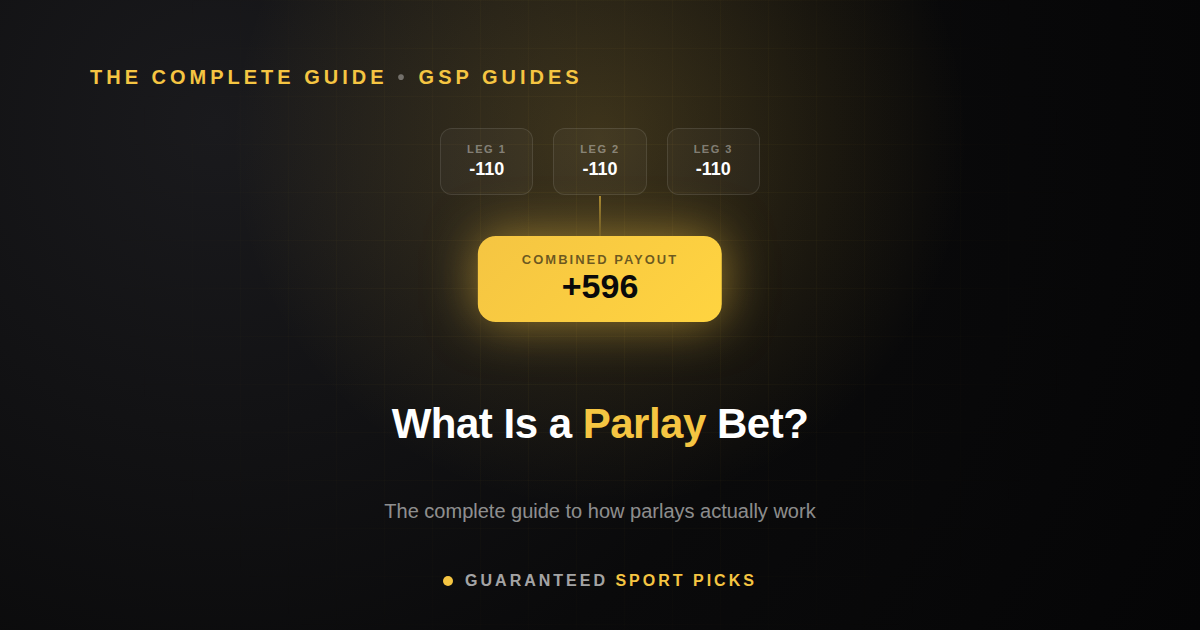
Each leg carries its own odds, and a parlay combines them by multiplying the decimal payout of every leg, not adding them. So a 3-team parlay does not pay three times what a single leg pays. It pays far more, because you are compounding the odds of every leg landing together.
Here is what that looks like with every leg at the standard -110 price. One leg on its own pays a little under even money. Stack them and the numbers climb fast:
A true coin flip would pay better than that. Three fair 50/50 legs should return 8 times your stake, while three legs at -110 return about 6.96 times. The gap is the sportsbook's cut, and it grows with every leg you add.
Why the same math favors the book
The book keeps its vig on every leg, and that cut compounds right alongside the payout. One -110 leg carries a house edge of about 4.5%. By the time you stack five or six of them, the edge is in the same neighborhood as keno, one of the worst bets in any casino.
That is the real reason parlays get the prime real estate in every app. They are fun to build, sure. They are also one of the most profitable products a sportsbook sells.
The parlay family
Once the basic parlay clicks, most of the other options on the menu turn out to be variations on it. Each one trades some payout for protection, or changes which legs get grouped together.
All three exist because a straight parlay is unforgiving. Missing one leg out of five costs you exactly as much as missing all five.
| Straight bets | Parlay | |
|---|---|---|
| What has to happen | Each bet wins or loses on its own | Every leg has to win |
| Payout if everything hits | Sum of each individual payout | Compounded, usually much larger |
| If one leg loses | You still collect on the others | The entire ticket loses |
| House edge | Standard edge on each bet | Grows with every added leg |
Same three picks, two very different weekends
Say you like three teams to cover this weekend, all at -110. You can bet them straight at $50 each, or put $50 on a single 3-team parlay. Here is how the two approaches play out:
| Result | Straight ($50 x 3) | Parlay ($50) |
|---|---|---|
| Go 3-0 | +$136.36 | +$297.90 |
| Go 2-1 | +$40.91 | -$50.00 |
| Go 1-2 | -$54.55 | -$50.00 |
| Go 0-3 | -$150.00 | -$50.00 |
The parlay caps your downside at the $50 stake and more than doubles the best case. In exchange, it throws away every result that is not a clean sweep.
Parlay questions we hear a lot
What is a parlay bet?
How are parlay odds calculated?
Do all the legs have to win?
What happens if one leg pushes?
Are parlays a bad bet?
Sports betting involves risk and is intended for entertainment purposes for adults 21 and older. Please bet responsibly. If you or someone you know has a gambling problem, call 1-800-GAMBLER.