




How MLB Bullpens Move Run Totals, and What to Track
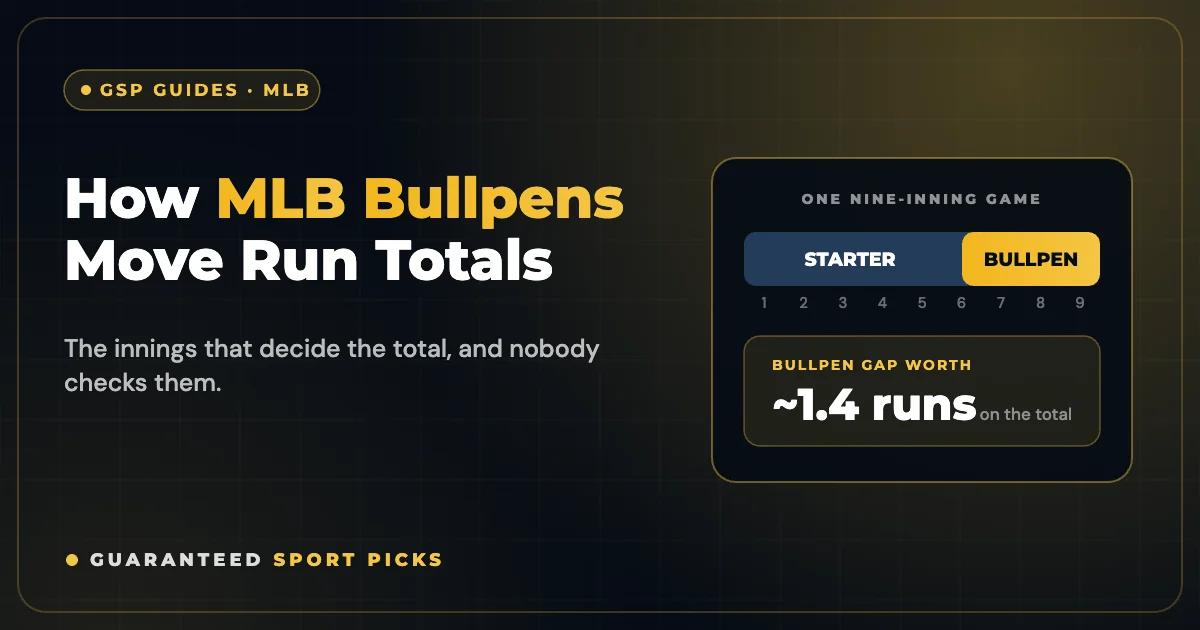
Almost everyone betting a baseball total starts with the two starting pitchers, and then stops. That made sense in an era when a starter routinely went eight innings. It makes much less sense now, when the back third of the game belongs to a rotating cast of relievers whose availability changes daily and is rarely priced as carefully as the names on the marquee.
Why the bullpen matters this much
Work the arithmetic. If a bullpen covers about three and a half innings and one side's relief corps runs an ERA around 3.00 while the other sits near 4.75, that gap is worth roughly 0.7 runs over those innings for that one team. Apply it to both bullpens in a game and you are looking at more than a run of difference in expected scoring, which is a large amount on a total set in the eight-and-a-half to nine range.
That is a simplified calculation and real games are messier, but the point holds: bullpen quality is not a rounding error on a run total. It is one of the largest inputs, and it moves from day to day in a way starting pitching does not.
What to actually track
The opener changes the shape of the game
When a team uses an opener, a reliever starting the game for an inning or two before handing off, the total is not really a starting pitcher matchup at all. It is a bullpen game, and the entire staff is in play. These games are priced differently and behave differently, and they are one of the clearest spots where checking the pitching plan beats checking the pitcher.
First five innings: betting the part you can actually handicap
If your read on a game is about the starters, there is a market that matches it. First five innings lines, often shown as F5, settle on the score after five innings, before most bullpens get involved. It is the baseball equivalent of a first half bet, and it lets you back a starting pitching edge without inheriting the bullpen risk you did not want.
The other inputs that move a total
- Ballpark. Run environments differ substantially from park to park, and the total already reflects it. Know whether your read is on top of that adjustment or duplicating it.
- Wind, not temperature. Wind direction at a park with a strong prevailing pattern is the weather factor that most reliably moves a total.
- Lineup news. A rest day for two middle-of-the-order bats matters more in baseball than most sports, because the lineup turns over a fixed number of times.
- Umpire tendencies. Strike zone size varies, and it is priced by sharper bettors. Treat it as a small factor, not a headline.
How this fits your betting
Bullpen research is the kind of edge that comes from doing work other people skip, which also means it is slow and it does not produce a play every night. That is fine. It pairs best with a disciplined approach to bankroll management and honest tracking of whether you are beating the number, which our guide to closing line value covers. If totals themselves are new to you, start with over/under betting.
Bullpen betting questions
How much does a bullpen affect an MLB run total?
What should I check before betting an MLB total?
What is an opener in baseball?
What is an F5 bet?
Does a reliever pitching two days in a row matter?
Sports betting involves risk and is intended for entertainment purposes for adults 21 and older. Please bet responsibly. If you or someone you know has a gambling problem, call 1-800-GAMBLER.