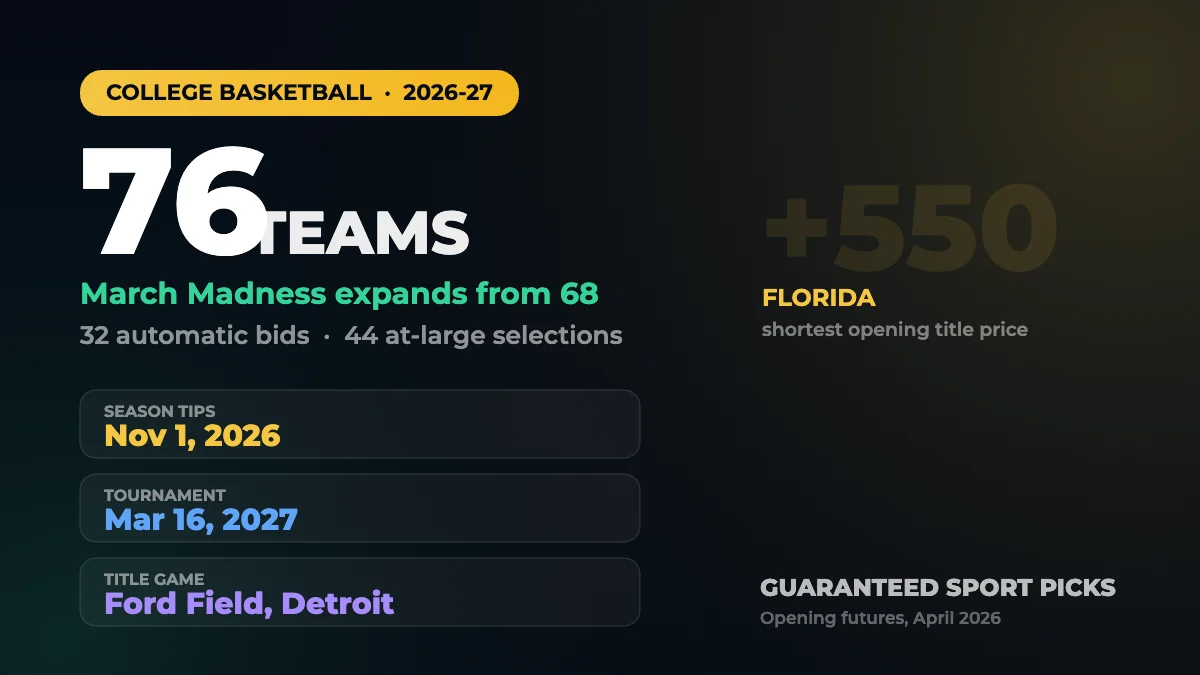
College basketball comes back on November 1, and it comes back structurally different. The men’s tournament expands from 68 teams to 76 this season, the regular season schedule limit rises to 32 games, and the whole thing ends at Ford Field in Detroit on April 5. If you bet this sport, the bracket math you have used for years just changed.
The idea in briefThe 2026-27 men’s college basketball season tips off November 1, 2026. March Madness expands to a 76-team field made up of 32 automatic conference bids and 44 at-large selections. The tournament runs March 16 through April 5, 2027, with the national championship at Ford Field in Detroit.
Nov 1
Season tips off
2026-27 opening day
76
Tournament field
Up from 68
44
At-large bids
Plus 32 automatic
Apr 5
National title game
Ford Field, Detroit
What the 76-team field actually changes
Eight extra spots sounds modest. It is not. Those eight teams come out of the at-large pool, which means the bubble moves down the board and a group of teams that would have spent March at home are now in the field. Two things follow from that for anyone betting the sport.
What gets easier
✓More mid-majors and bubble teams reach the tournament, which historically produces more first-weekend upsets
✓Regular season conference results matter slightly less for the marginal at-large team
✓Futures on second-tier programs carry a genuinely better path to simply making the field
A wider field means more games and more variance, which cuts both ways.
What gets harder
✗Historical seed-versus-seed data no longer maps cleanly onto the new bracket shape
✗Early-round lines will be less efficient while the market recalibrates, which is opportunity and risk at once
✗Bracket pool strategy built on 68 teams needs rethinking from scratch
Expect the first year of any format change to be the messiest one to price.
Rule changes worth knowing before you bet a total
Three changes were approved in May 2026, and two of them touch pace and possessions, which is exactly what totals are built on.
Approved rule changes, May 2026
| Change | Detail | Why a bettor cares |
|---|
| Backcourt violation | Called at 19 seconds on the shot clock instead of 20 | A marginal increase in turnover pressure, which nudges possession counts |
| Timeout handling | Game clock must run before a second timeout is granted when consecutive media timeouts would occur | Fewer dead-ball stoppages late, which affects end-of-game scoring and live totals |
| Schedule limit | Regular season game cap raised from 28 or 29 to 32 | More games, more data before March, and more fatigue variables in February |
Rule changes tend to have their largest effect on totals early in a season, before the market has enough new data to price them accurately.
The early title board
These are opening futures from April 2026, immediately after last season ended. They are a useful map of where the market started rather than a current price, and several of them will have moved significantly by tipoff. Check a live board before acting on any of them.
Implied title chance, top eight
Michigan State+1900 (5.0%)
FanDuel prices captured April 7, 2026. These are raw implied probabilities, not adjusted for the sportsbook margin. Unlike a two-way market, a futures board with hundreds of teams cannot be de-vigged from a partial list: the eleven teams below account for 72.5% of raw probability and the remainder is spread across the rest of the field plus the book’s hold.
See the full top eleven
| Team | Odds | Implied chance |
|---|
| Florida | +550 | 15.4% |
| Duke | +600 | 14.3% |
| Connecticut | +1200 | 7.7% |
| Illinois | +1300 | 7.1% |
| Michigan State | +1900 | 5.0% |
| Arizona | +2000 | 4.8% |
| Louisville | +2200 | 4.3% |
| Texas Tech | +2200 | 4.3% |
| Gonzaga | +3000 | 3.2% |
| Houston | +3000 | 3.2% |
| Tennessee | +3000 | 3.2% |
Florida and Duke opened clear of the field, with Connecticut and Illinois behind them. What matters more than the order is the shape: no team opened shorter than +550, which is a market saying it does not see a dominant favorite. Compare that to the NBA board, where two teams sit at +260 apiece, and you get a sense of how much wider college basketball’s range of outcomes is.
Key dates for the season
2026-27 men’s college basketball calendar
| Date | Event |
|---|
| November 1, 2026 | Season officially begins |
| March 16, 2027 | NCAA tournament begins, 76-team field |
| April 5, 2027 | National championship, Ford Field, Detroit |
Conference tournament dates and Selection Sunday follow the usual March pattern. We will publish a full bracket-betting guide closer to the tournament.
How we will cover the season
1
Totals first, in November
Early-season college basketball totals are the softest numbers on the board, because the market has almost no current-season data and two of this year’s rule changes affect pace.
2
Conference play from January
Once teams have a body of work, the spread market tightens and the edge moves toward situational spots rather than raw team quality.
3
Bracket work in March
With 76 teams the bracket math is new for everyone. We will publish a dedicated guide rather than recycling seed-based assumptions built on a 68-team field.
4
Futures throughout
Detailed national championship and conference futures breakdowns are coming as the preseason polls land. This piece is the starting map, not the full board.
College basketball season questions
When does the 2026-27 college basketball season start?
November 1, 2026. The NCAA tournament runs March 16 through April 5, 2027, with the national championship at Ford Field in Detroit.
How many teams make March Madness now?
76, starting this season. That is 32 automatic bids from conference tournaments and 44 at-large selections, up from 68 teams previously.
Who are the early favorites to win the 2027 national championship?
Florida opened at +550 and Duke at +600 in April 2026 futures, followed by Connecticut at +1200 and Illinois at +1300. Those are opening numbers and will have moved by tipoff.
Do the new rules affect betting totals?
They should, at least early. The backcourt violation moving to 19 seconds and the change to consecutive timeout handling both touch possession counts and late-game stoppages, and totals are priced on possessions.
How many games can a team play in the regular season now?
Up to 32, raised from the previous limit of 28 or 29. More games means more data before March, and more fatigue to account for late in the year.
We will be on the college board from opening night
Free picks daily, and premium picks under Pay After You Win so you are charged only when the pick wins. Full futures and bracket coverage is coming as the season develops.
Sports betting involves risk and is intended for entertainment purposes for adults 21 and older. Please bet responsibly. If you or someone you know has a gambling problem, call 1-800-GAMBLER.