




How to Read an NFL Odds Board, Column by Column
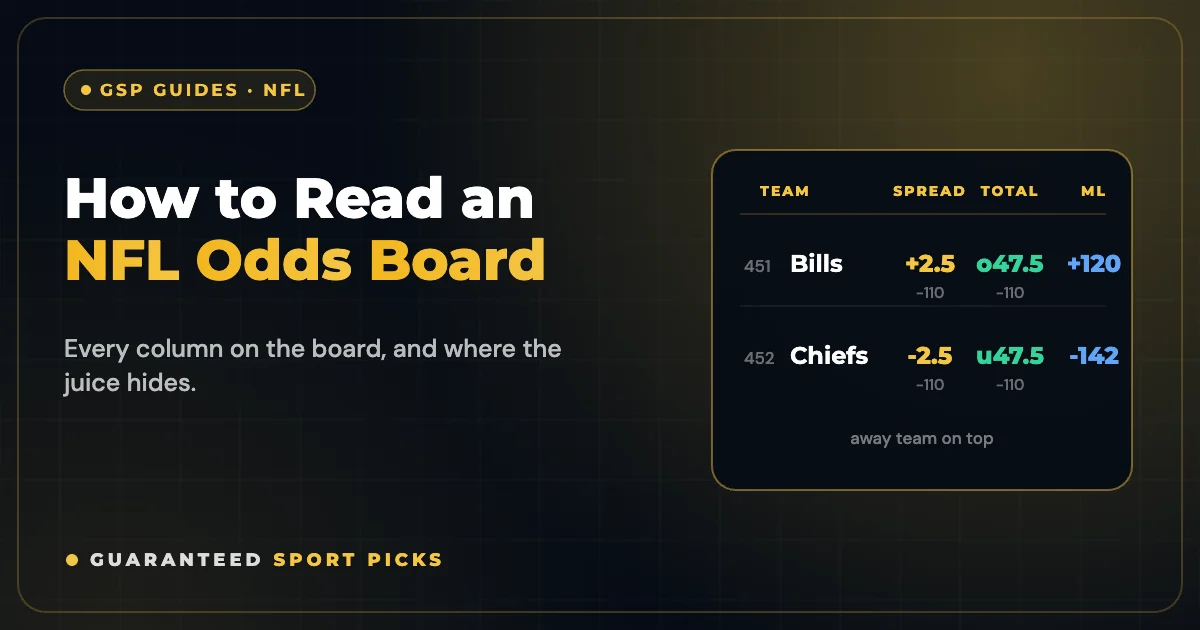
Open any sportsbook on a Sunday morning and you get a wall of numbers. Two team names, a handful of figures next to each, and a smaller number tucked beside them in grey. It looks like more information than it is. Every NFL odds board in the world shows the same six things, and once you can name them, the wall stops being a wall.
Rotation numbers
The small figures on the far left, often something like 451 and 452, are rotation numbers. They are a league-wide identifier for each side of each game, used so that a bet is unambiguous no matter what a book calls the teams. Consecutive numbers always belong to the same game, with the away side on the lower number. You can ignore them for online betting, but they are how you place a bet at a sportsbook counter, and they are handy for matching a game across two sites.
Which team is home?
The away team is listed first, on top. The home team sits underneath. Some books make it explicit with an "@" or the word "at" before the home side, and some just rely on the ordering. This matters more than it sounds, because misreading which side is home means misreading the entire line. If a board ever leaves you unsure, the game time and the stadium name will settle it.
The spread column
The spread is the margin the favorite has to beat. A team at -2.5 has to win by three or more. Its opponent at +2.5 covers by losing by two or fewer, or by winning outright. Whole numbers can push and refund your stake, half numbers cannot. Our guide to point spreads covers the mechanics in full.
In the NFL the number itself matters enormously, because games do not land on all margins equally. Far more games end with a margin of exactly 3 or exactly 7 than any other figure, which is why moving a line from -2.5 to -3.5 costs so much more than moving it from -5.5 to -6.5. That is the subject of our NFL key numbers guide, and it is the single most valuable thing to understand about reading NFL spreads specifically.
The number next to the number
Beside every spread sits a smaller figure, usually -110. That is the price, also called the juice or the vig, and it is the part most beginners skip. It tells you what you must risk to win $100. At -110 you are laying $110 to win $100, which means you need to win 52.38% of these bets just to break even.
Because it is printed smaller, the price gets ignored, and that is expensive. The same team at the same spread can be -105 at one book and -120 at another. Taking -105 instead of -110 lowers your break-even rate from 52.38% to 51.22%, which over a season is free money for the cost of opening a second account. Compare prices on our live odds board.
| Price | Risk to win $100 | Break-even win rate |
|---|---|---|
| -105 | $105 | 51.22% |
| -110 | $110 | 52.38% |
| -115 | $115 | 53.49% |
| -120 | $120 | 54.55% |
| +100 | $100 | 50.00% |
The total column
The total, or over/under, is the combined score of both teams. The board shows one number for the game with the over on the top row and the under below, each with its own price. A total of 47.5 means the over wins at 48 combined points and the under wins at 47. Overtime counts. See over/under betting for the full picture.
The moneyline column
The moneyline strips out the spread and asks only who wins. A minus number is the favorite and shows what you risk to win $100. A plus number is the underdog and shows what $100 returns. Our moneyline vs. point spread guide covers when each one is the better bet.
The misreads that cost money
Reading the board on a live odds page
A comparison board like ours adds one more dimension: the same game across several sportsbooks, side by side. Each column is a book, each cell is that book's number, and the best available price on each side is usually highlighted. The reading order is the same as a single book, you are just scanning across instead of down.
Questions about reading NFL lines
Which team is listed first on an NFL odds board?
What do the numbers like 451 and 452 mean?
What does the smaller number next to the spread mean?
Does -3 mean the same thing as -3.5?
Why do two sportsbooks show different numbers on the same game?
Sports betting involves risk and is intended for entertainment purposes for adults 21 and older. Please bet responsibly. If you or someone you know has a gambling problem, call 1-800-GAMBLER.