




Sports Betting Terms: 93 Betting Terms Explained in Plain English
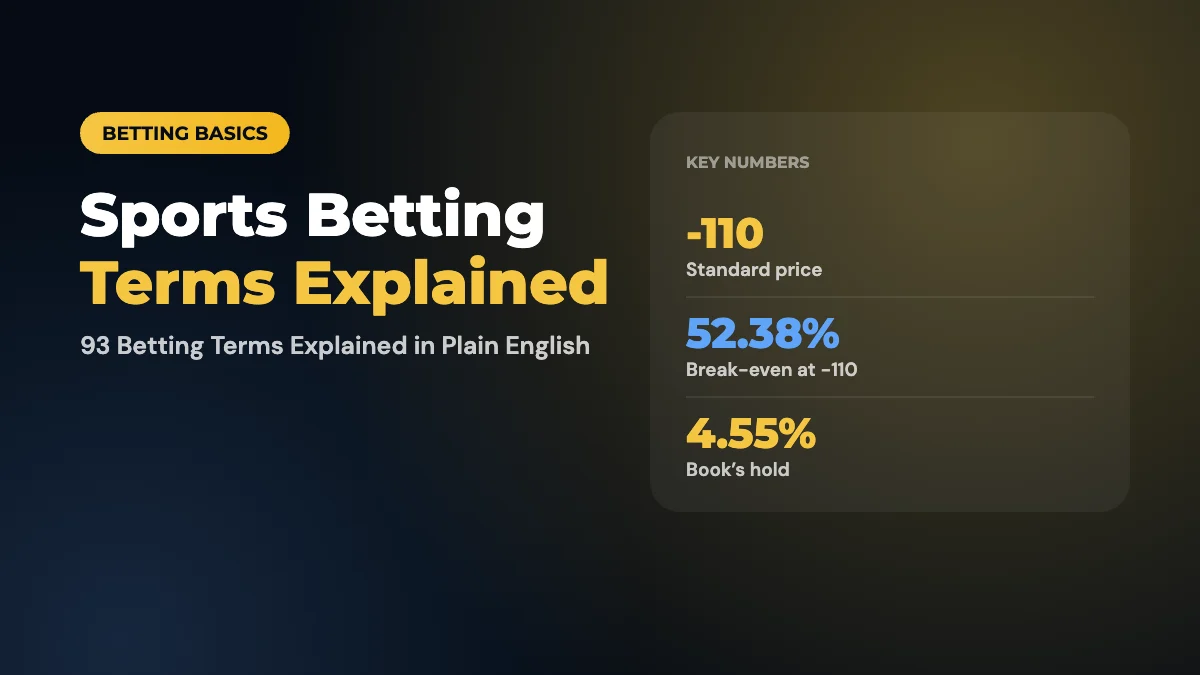
You open a betting app and the screen says Chiefs -3 (-110), Over 47.5, +450 to win the division. Every one of those numbers is a sports betting term with a precise meaning, and misreading one is the fastest way to lose money on a bet you meant to make. This glossary explains 93 sports betting terms in plain English, grouped the way you meet them: odds and lines, bet types, how bets settle, bankroll and money, and how the market moves, with links to our full guides where a term deserves more than a sentence.
Sports betting terms for odds and lines
These are the terms printed on every betting line. If you only learn one section, learn this one, and our guide to reading betting odds walks through a full board.
| Term | What it means |
|---|---|
| American odds | Odds shown with a plus or minus, like +150 or -110. See how to read betting odds. |
| Decimal odds | Odds shown as total return per $1, like 2.50. Common outside the U.S. |
| Fractional odds | Odds shown as a fraction, like 5/2. Common in the U.K. |
| Favorite | The team expected to win, shown with a minus sign. |
| Underdog | The team expected to lose, shown with a plus sign. |
| Dog | Short for underdog. |
| Point spread | The margin of victory a favorite must beat. See point spreads. |
| Spread price | The odds attached to a point spread, usually -110 on each side. The number in parentheses after the spread. |
| Moneyline | A bet on which team wins, with no spread. See moneyline vs. point spread. |
| Total | Short for the over/under number. |
| Over/under | A bet on whether the combined score goes over or under a number. See over/under bets. |
| Juice | The sportsbook's cut built into the odds. Also called vig. See the vig. |
| Vig (vigorish) | The sportsbook's built-in margin. At -110 on both sides, it works out to about 4.55% of the money bet. |
| Even money | Odds of +100. A $100 bet wins $100. |
| Pick'em (PK) | A game with no favorite. The spread is zero. |
| Hook | A half-point on a spread or total, like the .5 in -3.5. |
| Key numbers | Common final margins, mainly 3 and 7 in the NFL. See key numbers. |
| Implied probability | The win chance built into a set of odds. -110 implies 52.4%. |
| No-vig odds | Odds with the sportsbook's margin removed, showing the fair price. |
| Line | The current odds, spread or total on a game. |
| Opening line | The first odds posted on a game. |
| Closing line | The final odds before a game starts. |
| Lookahead line | An early number posted a week ahead, before the current week’s games are played. It often differs from the line that reopens after Sunday. |
| Off the board | A game with no line posted, often because of injury uncertainty. |
| Book | Short for sportsbook, the company that takes bets. |
Prices differ from book to book, sometimes by a full point on the spread or 20 cents on a moneyline. Comparing them before you bet is called line shopping, and our sportsbooks page lists the books we cover.
Betting terms for bet types
The spread, moneyline and total are the main markets. Everything else is built from them or sits beside them.
| Term | What it means |
|---|---|
| Straight bet | A single bet on one outcome, not part of a parlay. |
| Wager | Another word for a bet. |
| Parlay | A single bet that combines two or more picks, all of which must win. See parlays. |
| Same game parlay | A parlay with multiple legs from the same game. See same game parlays. |
| Correlated parlay | A parlay whose legs tend to win or lose together, like a team moneyline and its quarterback's passing yards. |
| Teaser | A parlay where you move each line in your favor in exchange for a lower payout. See teasers. |
| Round robin | A set of smaller parlays built from one list of picks. See round robin bets. |
| Prop bet | A bet on something other than the final result, like a player's yards. See prop bets. |
| Anytime touchdown | A prop that wins if a player scores at least one touchdown. See anytime TD bets. |
| Futures | Bets on outcomes decided later in the season, like a champion or award winner. See futures bets. |
| Win total | A futures bet on whether a team wins more or fewer games than a set number. |
| Live betting | Betting while a game is in progress. See live betting. |
| In-play | Another name for live betting. |
| Alternate line | A spread or total other than the main line, offered at adjusted odds. See alternate lines. |
| First half (1H) | A bet graded only on the halftime score. See first half betting. |
| Team total | An over/under on one team's points instead of both. |
| Puck line | Hockey's version of a point spread, usually 1.5 goals. |
| Run line | Baseball's version of a point spread, usually 1.5 runs. |
| Grand salami | A bet on the total goals or runs scored across all of a league's games on a given day. |
| Survivor pool | A contest where you pick one winner a week and are out after one loss. See survivor strategy. |
| Exchange or prediction market | A market where bettors trade contracts with each other and the platform takes a fee, instead of betting against a sportsbook. Kalshi, a CFTC-regulated exchange, and Polymarket both list sports contracts priced from 1 to 99 cents. |
Each of these has its own guide on Guaranteed Sport Picks: parlays, teasers, prop bets, futures and live betting.
How bets settle: win, lose or push
| Term | What it means |
|---|---|
| Cover | To win against the spread. |
| Against the spread (ATS) | A team's record or result measured against the point spread instead of wins and losses. See what ATS means. |
| Straight up (SU) | The plain win-loss result, ignoring the spread. |
| Push | A tie against the spread or total. Stakes are refunded. See pushes. |
| Action | Any bet that is live and will be graded. "No action" means a bet was canceled and refunded. |
| No action | A bet that is canceled and refunded, for example when a game is postponed. |
| Grading | How the sportsbook marks a bet once the game ends: win, loss, push or void. |
| Dead heat | A tie in a market such as "most passing yards." Payouts are usually reduced proportionally instead of refunded. |
| Bad beat | A bet that looked like a winner until something late flipped it. See bad beats. |
| Backdoor cover | A late, meaningless score that lets the losing team cover the spread. |
| Hedge | A bet placed against an earlier bet to lock in profit or reduce risk. See hedge bets. |
| Middle | Betting both sides at different numbers and winning both when the result lands in between. |
| Arbitrage | Betting every outcome of an event across different books at prices that guarantee a small profit. Sportsbooks often limit accounts that do it. |
| Cash out | Settling a bet early with the sportsbook at a price it offers before the game ends. |
More on hedging and middling in our guides to hedge bets and pushes.
Bankroll and money terms
| Term | What it means |
|---|---|
| Bankroll | The money set aside only for betting. See bankroll management. |
| Unit | A standard bet size, usually a set percentage of your bankroll. See units. |
| Stake | The amount risked on one bet. |
| To win | The profit a bet pays, not counting your stake back. A $110 bet at -110 is "to win $100". |
| Payout (return) | Profit plus stake. A $110 bet at -110 returns $210. |
| ROI (return on investment) | Profit divided by the total amount risked, the fairest way to compare bettors who bet different amounts. |
| Break-even percentage | The win rate needed to stay even at a given price. At -110 it is 52.38%, which is why winning half your bets loses money. |
| Expected value (EV) | The average profit or loss per bet over the long run. See expected value. |
| Kelly criterion | A formula that sizes bets based on your estimated edge. Most bettors who use it bet a fraction of it. |
| Dime | Slang for a $1,000 bet. |
| Nickel | Slang for a $500 bet. |
| Limit | The maximum amount a sportsbook will accept on a bet. |
| Bonus bet | Site credit from a sportsbook promotion. A winning bonus bet usually pays the profit only, not the credit back. |
| Rollover (playthrough) | How many times bonus money must be wagered before it can be withdrawn. |
| Odds boost | A sportsbook promotion that pays more than the normal price on a specific bet. |
Our bankroll management and unit sizing guides cover this in detail.
Sharp money, steam and other market terms
These terms describe how lines move and who moves them. They show up in every preview and line-movement table on Guaranteed Sport Picks.
| Term | What it means |
|---|---|
| Sharp | A skilled, often professional bettor whose action moves lines. See sharp money. |
| Square | A casual or recreational bettor. |
| Public money | Bets from casual bettors, who tend to back favorites and overs. |
| Steam | Sudden, fast line movement across many books at once, usually from sharp money. |
| Line movement | Changes in the odds between when a line opens and when it closes. |
| Reverse line movement | When a line moves against the side most bets are on, often a sign of sharp money on the other side. |
| Line shopping | Comparing prices across sportsbooks to get the best number. Try our live odds page. |
| Buying points | Paying extra juice to move the spread or total in your favor. See buying points. |
| Closing line value (CLV) | How much better your price was than the closing line. See closing line value. |
| Handle | The total amount of money wagered on a game or across a sportsbook. |
| Hold | The share of the money wagered that a sportsbook keeps as profit. |
| Overlay | A price better than the true chance deserves, or a contest whose prize pool is bigger than the entry fees collected. |
| Fade | To bet against a team, a trend or another bettor's picks. |
| Mush | A bettor, or a pick, thought to bring bad luck. |
| Lock | A pick someone considers a sure thing. There is no such thing. |
| Chalk | The favorite, especially a heavy one. See what chalk means. |
| Tout | Someone who sells picks. Always check a tout's track record and terms. |
| Handicapper | Someone who studies games and makes picks, often for paying clients. |
Read more in our guides to closing line value, sharp money and buying points.